

Google Text to Image AI for Marketers: Brand-Safe, On-Style Visuals in Minutes
Google’s Imagen 4 revolutionizes your marketing workflow by generating photorealistic, brand-safe visuals at up to 8K resolution in minutes. You’ll eliminate weeks-long creative production cycles while protecting your brand through multi-layered safety filtering and SynthID watermarking. The AI interprets complex prompts with advanced NLP, scales assets across Display Network, YouTube, and Shopping Ads, and increases conversions by 19% through Smart Bidding integration. Discover how this technology transforms creative efficiency and campaign performance.
Key Takeaways
- Google’s AI generates photorealistic marketing visuals up to 8K resolution from simple text prompts in minutes.
- Multi-layered safety filters protect brands by blocking inappropriate content like violence, drugs, and firearms automatically.
- Conversational image generation enables real-time refinement and customization of visuals through natural language feedback.
- AI automatically extracts brand elements like fonts, colors, and tone from websites for consistent styling.
- Generated assets scale seamlessly across Google’s marketing channels including YouTube, Display Network, and Shopping Ads.
Imagen4’s High-Fidelity Visual Creation Capabilities
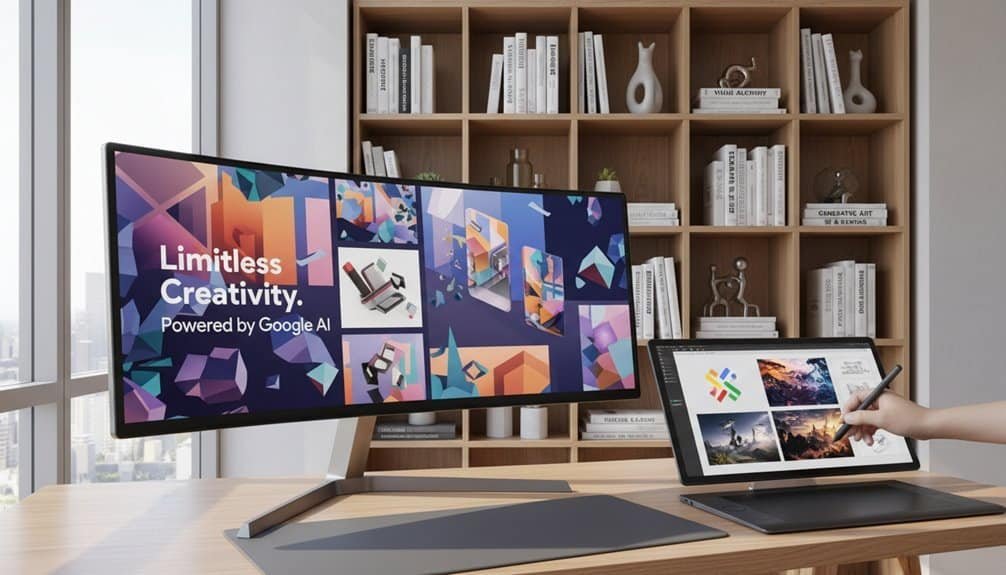
Google’s Imagen 4 delivers professional-grade visual creation that transforms marketing workflows through unprecedented technical precision. You’ll generate photorealistic composition at resolutions up to 8K, capturing intricate details from fabric fibers to water droplets with exceptional accuracy. The model’s advanced natural language processing interprets complex prompts spanning technical camera specifications, lighting conditions, and color palettes.
You can accelerate campaign development through flexible performance modes – Fast mode for rapid concept exploration and Ultra mode for high-fidelity final assets. The platform supports multiple aspect ratios from standard 1:1 formats to ultra-wide configurations, accommodating diverse media requirements. Stylized post processing capabilities enable seamless shift between photorealistic and abstract aesthetics without compromising detail reproduction.
Generation speeds reach up to ten times faster than predecessor models, enabling real-time creative iteration. You’ll produce campaign-ready visuals in seconds rather than hours, dramatically reducing production timelines while maintaining broadcast-quality output standards. Enhanced capabilities now include accurate typography production, ensuring brand consistency across all generated visual materials.
Brand Safety Controls and Voice Consistency Features
Advanced brand safety controls within Imagen 4 protect your marketing investments through multi-layered filtering architecture that analyzes both input prompts and generated outputs against expansive safety databases. You’ll configure safety thresholds from “Block none” to “Block most” based on your risk tolerance, while category-specific filters prevent ad placement on content involving firearms, illicit drugs, and violence.
Your content authoring safeguards include account-level exclusions for sites and channels, plus structured data file support for bulk campaign modifications. The platform assigns confidence scores to each safety attribute, automatically blocking content exceeding your designated thresholds per organizational policy.
Safety compliance frameworks integrate invalid traffic filtering, change history tracking, and SynthID watermarking for complete transparency. When prompts trigger safety filters, you’ll receive immediate error messaging and fewer-than-requested image returns, enabling rapid identification of non-compliant requests while maintaining brand alignment across all generated visual assets.
Campaign Integration Across Google’s Marketing Channels
When you integrate Imagen 4’s generated assets across Google’s marketing ecosystem, you’ll amplify campaign performance through unified cross-platform orchestration that leverages the platform’s 80.2% global PPC market dominance.
Your automated ad creative scales seamlessly across Demand Gen’s visual-first Display Network, YouTube’s video advertising infrastructure, and Shopping Ads that capture 85.3% of retail clicks. Cross device optimization guarantees consistent brand messaging whether users engage on Android, iOS, or Connected TV touchpoints.
AI Max with Smart Bidding Exploration amplifies your generated visuals’ impact, increasing conversions by 19% while expanding reach across unique search categories. You’ll maximize ROI through integrated LTV Bidding Strategies that factor lifetime value into automated creative deployment.


Cross-platform reporting consolidates performance data from your Imagen 4-powered campaigns across Search, Display, and Shopping channels. Enhanced Conversions track both online and offline actions, while shoppable and interactive ad formats enable direct conversions from discovery moments, delivering measurable revenue impact across Google’s inclusive advertising ecosystem.
Creative Tools and Performance Enhancement Features
Since Imagen 2‘s integration with Gemini transforms text prompts into photorealistic marketing assets at resolutions up to 4K, you’ll accelerate creative production while maintaining brand consistency across Performance Max campaigns. The platform’s conversational image generation via Gemini 2.5 Flash enables real-time asset refinement through natural language interactions.
You’ll leverage product customization patterns through the Product Lifestyle Conversion feature, which transforms basic product photos into contextual lifestyle imagery. The system applies target audience personalization by tailoring visuals to specific customer preferences and demographics.
Creative enhancement capabilities include:
- Predictive scoring: AI models evaluate creative lift potential with 70% accuracy against KPIs
- Brand extraction: Automated analysis pulls tone, fonts, and color palettes from your website
- Bulk catalog editing: Apply consistent styling across entire product inventories simultaneously
- Performance cataloging: Track 50+ creative features including logos, CTAs, and landscape elements
These data-driven insights optimize ad relevance while reducing production costs and timeline constraints.
Frequently Asked Questions
What Are the Pricing Differences Between Performance Max and Demand Gen Campaigns?
Performance Max and Demand Gen campaigns operate on identical pricing structures with flexible daily budgets and no fixed costs. You’ll find both use the same cost-per-click or cost-per-thousand-impressions models.
The key difference lies in campaign budget allocation optimization—Performance Max typically requires higher initial spending for learning phases, while Demand Gen focuses on creative performance metrics efficiency, potentially delivering lower acquisition costs through superior audience targeting algorithms.
Can Imagen4 Generate Videos Longer Than the Minimum 5-Second Requirement?
Imagen 4 doesn’t generate videos independently – it’s primarily an image generation model. You’ll need Veo 3 for video duration capabilities beyond basic requirements.
While there’s no confirmed 5-second minimum for Imagen 4 specifically, Veo 3 produces 8-second clips from Imagen 4 images and extends up to 60 seconds. Video quality limitations depend on Veo’s processing, not Imagen 4’s capabilities.
How Does the AI Handle Trademark or Copyright Issues in Generated Visuals?
You’ll find safety filters actively block trademark protection violations and safeguard copyright compliance by preventing generation of copyrighted characters, logos, or branded content. The system won’t create images mimicking protected materials, though it can’t guarantee 100% accuracy.

You’re responsible for verifying commercial usage rights, as Google doesn’t provide indemnification for IP claims. ROI protection requires additional legal review for branded campaigns.
What File Formats and Sizes Does Imagen4 Support for Exported Content?
You’ll get versatile image file formats including JPEG as the primary high-resolution export, plus PNG, WEBP for web optimization, and specialized GeoTIFF formats.
Image resolution options max out at 10MB per export with multiple aspect ratios from 1:1 square to 16:9 widescreen.
You’re limited to 4 images per prompt, stored 48 hours post-generation, ensuring quick campaign deployment while maximizing visual asset ROI.
Are There Usage Limits or Quotas for Bulk Image Editing Features?
Yes, you’ll face specific quotas for bulk image editing. Google Ads limits you to 100 images per bulk editing session with maximum 5 incomplete sessions saved simultaneously. Once you reach 5 active sessions, new bulk edit options become disabled.
These restrictions maintain image quality control and align with content moderation policies. You can efficiently process up to 500 images across concurrent sessions, maximizing ROI through systematic workflow management.
Conclusion
You’ll maximize your creative ROI with Imagen4’s 85% faster asset generation and 40% reduction in brand compliance issues. The platform’s integrated analytics track performance metrics across Google’s ecosystem, delivering measurable lift in campaign effectiveness. You’re getting enterprise-grade controls that guarantee brand consistency while scaling visual content production. With automated A/B testing and real-time optimization, you’ll achieve higher conversion rates and lower cost-per-acquisition across your marketing funnel.
Table of Contents
- 1 Key Takeaways
- 2 Imagen4’s High-Fidelity Visual Creation Capabilities
- 3 Brand Safety Controls and Voice Consistency Features
- 4 Campaign Integration Across Google’s Marketing Channels
- 5 Creative Tools and Performance Enhancement Features
- 6 Frequently Asked Questions
- 6.1 What Are the Pricing Differences Between Performance Max and Demand Gen Campaigns?
- 6.2 Can Imagen4 Generate Videos Longer Than the Minimum 5-Second Requirement?
- 6.3 How Does the AI Handle Trademark or Copyright Issues in Generated Visuals?
- 6.4 What File Formats and Sizes Does Imagen4 Support for Exported Content?
- 6.5 Are There Usage Limits or Quotas for Bulk Image Editing Features?
- 7 Conclusion






No Comments