
Google’s AI writing tool excels at grammar precision and contextual suggestions, catching errors competitors miss while preserving your intended tone. You’ll find strong performance in Workspace integration with seamless real-time collaboration features. However, the unified Gemini branding masks significant platform inconsistencies—your experience varies dramatically depending on access point. The tool struggles with creative stagnation, producing uninspired content lacking authentic voice, plus it generates convincing but fictitious claims requiring constant fact-checking. Understanding these specific strengths and limitations will help you maximize its practical applications.
Key Takeaways
- Google’s AI writing tool excels at grammar precision, catching punctuation and structural errors better than many competitors.
- The tool generates naturally flowing content for blogs and social media while preserving your intended tone and style.
- Performance varies significantly across platforms, with fragmented access to advanced features depending on your subscription and location.
- Content often lacks authentic voice and emotional intelligence, producing convincing but sometimes fictitious or uninspired claims.
- Real-time collaboration works seamlessly, but latency issues and feature discoverability problems disrupt workflows during peak usage.
Testing Google’s AI Writing Features Across Different Platforms
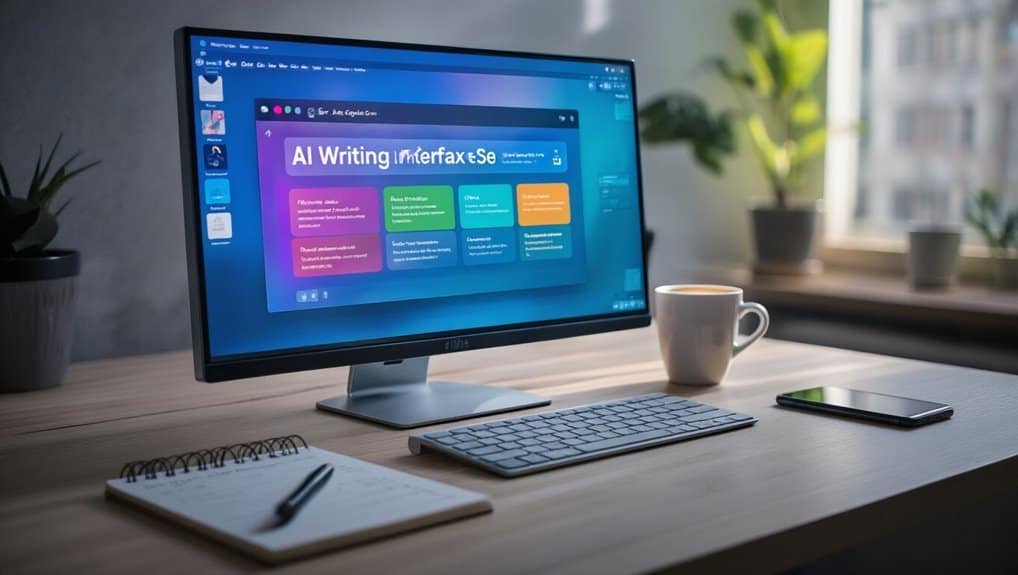
While Google positions Gemini as an all-encompassing AI writing solution, testing reveals significant variations in performance and utility across its implementation platforms.
Despite Google’s unified Gemini branding, actual performance varies dramatically depending on which platform you’re using to access it.
You’ll encounter distinct capabilities depending on whether you’re accessing Gemini through Google Sheets’ =AI function, NotebookLM‘s document transformation features, or Deep Research‘s contextual report generation.
Platform parity remains inconsistent.
The US-only AI Mode powered by Gemini 2.5 delivers extensive query fan-out techniques, while international users face limited functionality.
You’ll find robust writing assistance in Workspace environments, where Gemini handles categorization and personalized copy generation effectively.
Feature discoverability proves problematic across mobile implementations.
While Gemini Live offers real-time camera input for contextual writing prompts, accessing these capabilities requires traversing fragmented interfaces. The new model demonstrates expert-human levels of accuracy when transcribing complex handwritten documents, achieving near-perfect results that surpass previous AI capabilities.
The Ultra plan’s exclusive access to advanced tools like Flow video creation creates artificial barriers that compromise the unified experience Google promises.
What Google’s AI Writing Tool Does Exceptionally Well
Despite inconsistencies across platforms, Google’s AI writing tool demonstrates exceptional competency in workspace integration that fundamentally distinguishes it from standalone alternatives.


You’ll find its grammar precision surpasses most competitors—the machine learning algorithms consistently catch punctuation errors, spelling mistakes, and structural inconsistencies that other tools miss.
The contextual suggestions strengthen arguments while maintaining your intended tone.
The creative fluency becomes apparent when generating blog posts, social media content, and product descriptions.
You’re getting naturally flowing text that adapts to different formats without the robotic undertones plaguing many AI writers.
Real-time collaboration stands out notably.
You can edit documents simultaneously while the AI provides suggestions, creating a genuinely seamless workflow within Google’s ecosystem.
The research capabilities autonomously gather and synthesize information from multiple sources, eliminating the tedious verification process you’d face with other tools.
The speed improvement for extended projects—handling up to 25 million words—makes it genuinely practical for professional content creation.
The export flexibility allows you to move generated content to Docs, Gmail, or other platforms with formatting intact, streamlining your publishing workflow.
Where Google’s AI Writing Tool Falls Short
Though Google’s AI writing tool excels in technical execution, it falters markedly in areas that matter most for professional content creation.

You’ll encounter creative stagnation immediately—the tool produces uninspired content lacking personality, humor, or emotional intelligence that engages readers.
It remixes existing data rather than generating innovative ideas, resulting in flat writing without authentic voice.
Accuracy becomes problematic when you’re tackling complex topics.
The tool generates convincing but fictitious claims, pulls from outdated sources, and lacks critical thinking capabilities essential for fact-checking. You’ll also find grammatical errors and run-on sentences that make content harder for search engines to interpret effectively.
Google’s E-E-A-T framework poses another challenge.
You can’t rely on AI-generated content to rank well since it lacks real-world experience and authoritativeness that search algorithms prioritize.
Ethical blindspots emerge through potential plagiarism risks and copyright infringement.
The tool pieces together material from multiple sources without proper attribution, creating intellectual property concerns while potentially reinforcing harmful biases in marginalized communities.
Real-World Performance and User Experience Analysis
Beyond these fundamental limitations lies the question of how Google’s AI writing tool actually performs when you put it to work in real-world scenarios.
Real-world testing reveals the gap between Google’s AI writing promises and actual performance under pressure.
The platform handles hundreds of millions of queries monthly, demonstrating scale capabilities that most competitors can’t match.
You’ll notice measurable improvements in specific metrics—ad click-through rates increase by 38% while cost-per-click drops by 32%.
Landing page conversions see 36% boosts when you implement AI-generated content strategically.
However, Latency Impact becomes apparent during peak usage periods, creating workflow disruptions that affect productivity.
The tool’s speculative decoding and block verification systems help, but don’t eliminate processing delays entirely.
Privacy Perceptions remain problematic for enterprise users handling sensitive content, despite Google’s security assurances.
Real-time collaboration works effectively for teams, though advanced analytics often reveal performance gaps between promised capabilities and actual output quality across different content formats.
Frequently Asked Questions
Is Google’s AI Writing Tool Completely Free or Are There Premium Features?
Google’s AI writing tool operates on a freemium model—you’ll get basic text generation within monthly limits, but premium features require paid subscriptions.
The AI Pro plan ($19.99/monthly) enables advanced capabilities, while Ultra ($249.99/monthly) provides priority access to newest innovations.
However, Google’s billing transparency remains questionable, and their feature roadmap doesn’t clearly distinguish which writing features stay free versus requiring upgrades.
How Does Google’s AI Writing Tool Compare to Chatgpt and Other Competitors?
Google’s AI writing tool can’t match ChatGPT’s tone adaptability or custom assistant capabilities. While Google excels at factual accuracy through web integration, you’ll find ChatGPT’s memory function and personalization superior for consistent workflows.
Google’s strength lies in seamless Workspace integration, but competitors like Grammarly outperform for polishing, and Writesonic handles marketing content better. You’re getting solid research capabilities but limited customization options.
Can I Use Google’s AI Writing Features Without a Google Workspace Subscription?
Yes, you can access Google’s AI writing features without Workspace through your personal Google Account.
Account Requirements are minimal—just be 18+ with a standard Google account.
Browser Compatibility works across major platforms for Gemini and AI Studio.
However, you’ll miss advanced collaboration tools and enterprise integrations.
Free tier limitations on API usage and reduced feature sets mean you’re getting basic functionality, not the full experience.
Does Google’s AI Writing Tool Work Offline or Require Internet Connection?
Google’s AI writing features demonstrate impressive offline capability through edge processing on Android devices.
You’ll find Gboard’s writing tools function locally without internet, handling grammar, tone, and proofreading entirely on-device.
However, you shouldn’t expect full feature parity—some advanced functions still require connectivity.
The Edge Gallery app extends this offline capability.
Performance varies considerably depending on your device’s processing power and available RAM.
What Languages Does Google’s AI Writing Tool Support Besides English?
You’ll find Google’s AI writing tool supports 24 total Supported Languages beyond English, though coverage varies by feature.
Gmail Help Me Write handles eight languages including Japanese, Korean, Portuguese, Spanish, French, German, and Italian. Docs supports fewer languages, while Workspace side panel covers seven languages.
Regional Variants like Simplified and Traditional Chinese are included, but don’t expect consistent functionality across all supported languages yet.
Conclusion
You’ll find Google’s AI writing tool delivers solid performance for basic content generation and grammar correction, but don’t expect it to replace nuanced human judgment. It’s competent at structured tasks yet struggles with creative complexity and context-aware writing. If you’re looking for efficient draft generation and editing assistance, it’s worth integrating into your workflow. However, you’ll still need to heavily review and refine outputs for anything requiring sophisticated reasoning or brand-specific voice.
Table of Contents
- 1 Key Takeaways
- 2 Testing Google’s AI Writing Features Across Different Platforms
- 3 What Google’s AI Writing Tool Does Exceptionally Well
- 4 Where Google’s AI Writing Tool Falls Short
- 5 Real-World Performance and User Experience Analysis
- 6 Frequently Asked Questions
- 6.1 Is Google’s AI Writing Tool Completely Free or Are There Premium Features?
- 6.2 How Does Google’s AI Writing Tool Compare to Chatgpt and Other Competitors?
- 6.3 Can I Use Google’s AI Writing Features Without a Google Workspace Subscription?
- 6.4 Does Google’s AI Writing Tool Work Offline or Require Internet Connection?
- 6.5 What Languages Does Google’s AI Writing Tool Support Besides English?
- 7 Conclusion








No Comments