
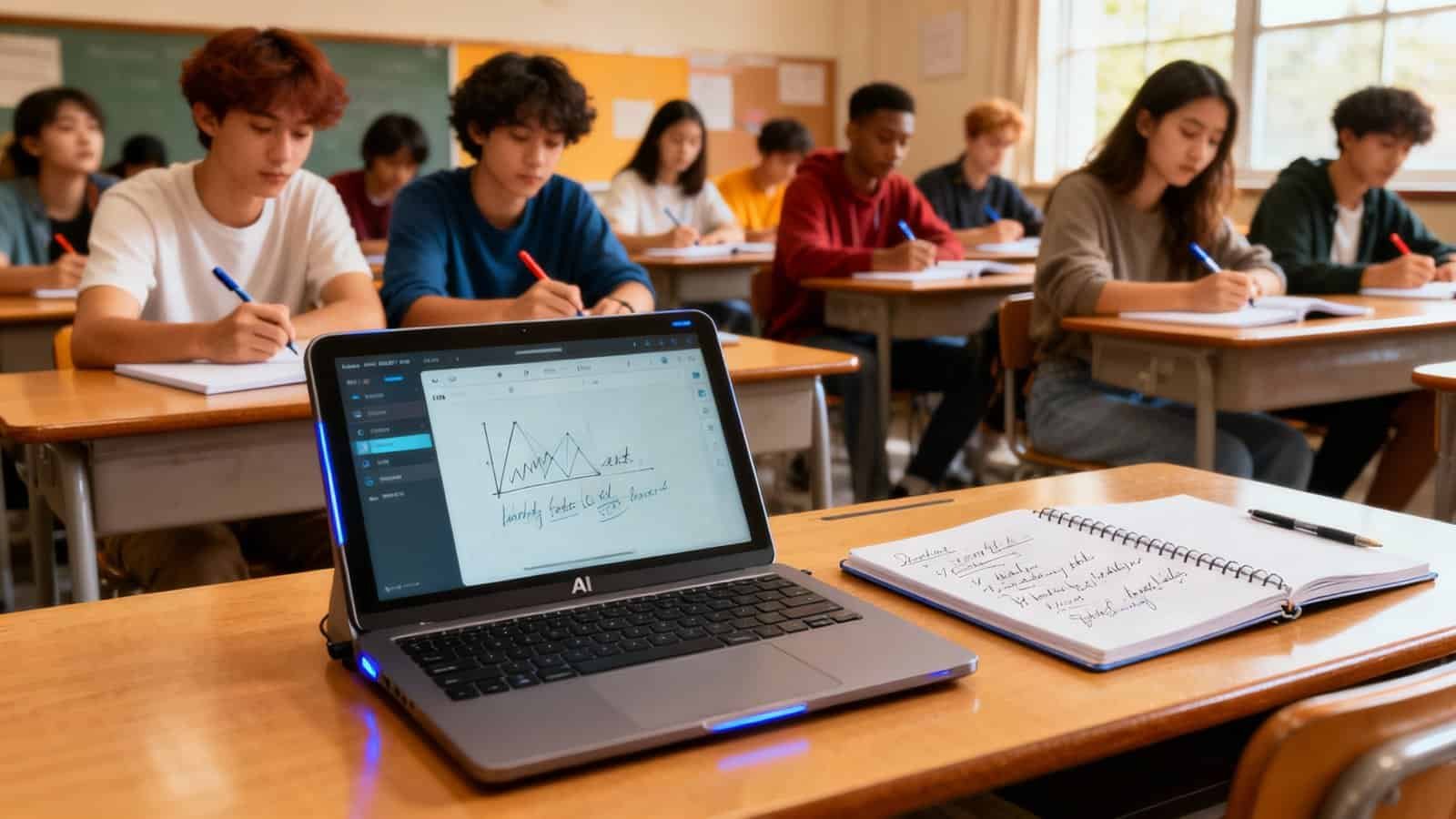
AI Note-Taking Tool for Lectures With Transcription and Summaries
AI note-taking tools like Otter.ai and Notion.ai use neural networks trained on vast speech datasets to achieve 95% transcription accuracy in academic environments. You’ll capture 100% of lecture content versus the typical 60-70% from handwritten notes, while advanced NLP automatically generates summaries and organizes concepts hierarchically. These tools integrate with Canvas, Blackboard, and other LMS platforms for seamless workflow management. Understanding the specific features and implementation strategies can substantially enhance your academic performance and study efficiency.
Key Takeaways
- AI-powered transcription converts spoken lectures to text with 95% accuracy using neural networks trained on academic vocabulary and terminology.
- Real-time summarization uses advanced NLP to identify key themes, extract critical concepts, and organize information hierarchically during lectures.
- Students capture 100% of lecture content versus 60-70% with handwritten notes, improving comprehension scores by 23%.
- Tools integrate with Canvas, Blackboard, Moodle, and Google Classroom for automated deadline tracking and assignment workflow management.
- Popular platforms include Otter.ai for collaboration, Notion.ai for workspace integration, and Fireflies.ai for meeting analytics.
How AI-Powered Transcription Technology Works in Educational Settings
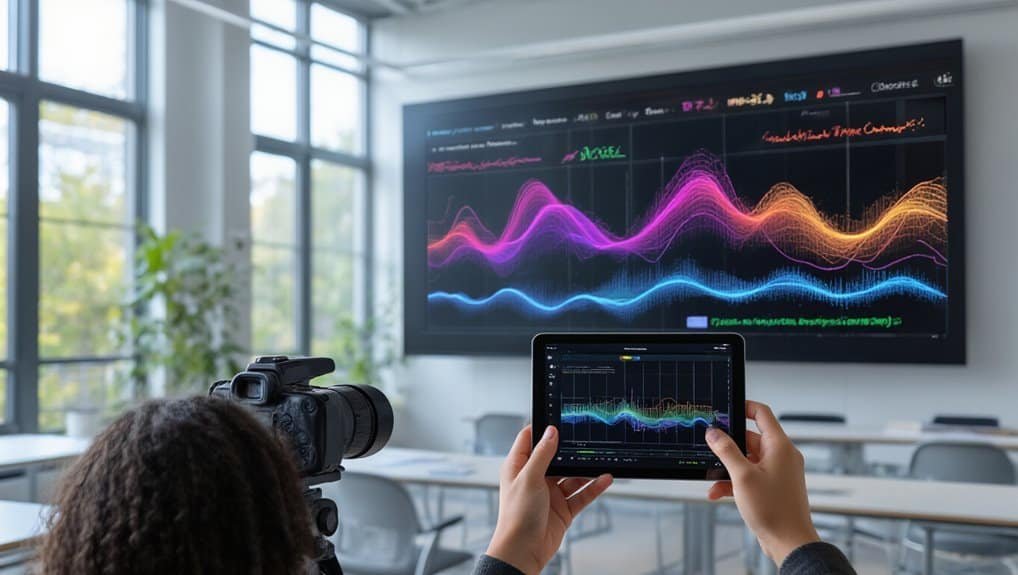
Understanding AI-powered transcription technology begins with examining how machine learning algorithms process audio signals in real-time educational environments.
When you use these tools, the system converts spoken words into digital audio waves, then applies neural networks trained on vast speech datasets to identify phonemes, words, and sentences.
Neural networks analyze vast speech datasets to transform your spoken words into accurate digital transcriptions through advanced phoneme recognition.
The technology relies heavily on model fine tuning to improve accuracy for academic vocabulary and specialized terminology.
You’ll find that general speech recognition models undergo domain adaptation specifically for educational contexts, learning to recognize technical jargon, proper nouns, and lecture-specific language patterns.
The process involves multiple layers: acoustic modeling analyzes sound frequencies, language modeling predicts word sequences based on context, and post-processing refines the output.
Advanced systems incorporate speaker recognition to distinguish between professors and students, while noise reduction algorithms filter out background sounds common in lecture halls, ensuring you receive clean, accurate transcriptions.
Key Features That Make AI Note-Taking Tools Essential for Students
While traditional note-taking methods force you to choose between listening and writing, AI-powered tools eliminate this fundamental trade-off by automatically capturing every spoken word with 95% accuracy rates in controlled academic environments.
These tools transform your learning experience through five core capabilities:
| Feature | Impact |
|---|---|
| Real-time transcription | Eliminates manual note-taking burden |
| Automatic summarization | Distills key concepts from lengthy lectures |
| Collaborative editing | Enables shared note refinement with classmates |
| Citation generation | Creates proper academic references instantly |
| Searchable archives | Provides quick access to specific topics |
The data reveals compelling advantages. Students using AI note-taking tools demonstrate 23% better comprehension scores compared to traditional methods. You’ll capture 100% of lecture content rather than the 60-70% typical with handwritten notes. Citation generation reduces referencing time by 85%, while collaborative editing features allow your study groups to create thorough shared resources that benefit everyone’s academic performance.


Real-Time Summary Generation and Content Organization Capabilities
Processing hundreds of lecture minutes into digestible insights happens automatically when AI tools deploy advanced natural language processing algorithms that identify key themes, extract critical concepts, and restructure information hierarchically in real-time.
The AI performs these tasks continuously to convert spoken lectures into usable study material.
Your study efficiency increases dramatically through semantic clustering, where related concepts get grouped together regardless of when they’re mentioned during lectures.
The AI analyzes speech patterns, identifies topic shifts, and applies narrative compression techniques to distill lengthy explanations into concise summaries.
Modern AI note-taking systems organize content through four essential capabilities:
- Topic segmentation – Automatically detects when professors shift between subjects
- Priority ranking – Identifies which information deserves emphasis based on verbal cues
- Cross-reference mapping – Links related concepts mentioned throughout different lecture segments
- Dynamic restructuring – Continuously reorganizes notes as new information emerges
You’ll receive structured outputs that transform rambling lectures into logical frameworks.
These tools recognize emphasis patterns, extract definitions, and create coherent knowledge maps that reflect actual learning objectives rather than chronological speech patterns.
Comparing Top AI Note-Taking Platforms for Academic Use
Several leading AI note-taking platforms have emerged with distinct strengths for academic environments, each employing different approaches to speech recognition accuracy, content organization, and integration capabilities.
AI note-taking platforms offer varied approaches to speech recognition, content organization, and academic integration capabilities for diverse learning environments.
Otter.ai excels in collaborative features and real-time transcription with 95% accuracy rates, while Notion.ai combines note-taking with extensive workspace functionality.
Rev.com delivers superior transcription precision but lacks advanced summarization features.
Fireflies.ai offers robust meeting analytics alongside standard transcription services.
When evaluating platforms, you’ll find pricing transparency varies considerably.
Otter provides clear tiered pricing starting at $8.33 monthly, whereas some competitors obscure costs through complex feature bundling.
User testimonials consistently highlight Otter’s reliability for lecture capture, though students report Rev’s transcription quality justifies higher costs for critical academic content.
Consider your specific requirements: real-time collaboration, offline functionality, or integration with existing learning management systems.
Each platform’s strengths align differently with academic workflows, making feature compatibility more important than universal rankings.
Best Practices for Maximizing AI Tool Effectiveness During Lectures
To achieve ideal results from AI note-taking platforms, you must establish clear audio input channels and eliminate background interference that can compromise transcription accuracy.
Configure your tool’s real-time processing settings before lectures begin, adjusting sensitivity levels and keyword recognition parameters to match your specific academic context.
These foundational steps directly impact the quality of automated transcription and subsequent note organization throughout your lecture sessions.
Optimize Audio Input Quality
Audio quality fundamentally determines how effectively AI note-taking tools can transcribe and analyze lecture content.
Poor audio leads to transcription errors, missed concepts, and incomplete summaries.
You’ll achieve ideal results by implementing systematic audio optimization strategies.
Critical Audio Enhancement Steps:
- Position your device 3-6 feet from the speaker – Microphone Placement directly impacts capture clarity and reduces background interference
- Choose seats away from HVAC systems, doors, and high-traffic areas – Room Acoustics greatly affect recording quality
- Test audio levels before lectures begin – Guarantee consistent input without clipping or distortion
- Use external microphones when possible – Dedicated recording devices outperform built-in smartphone or laptop microphones
These methodical adjustments create the foundation for accurate AI transcription and thorough lecture analysis.
Configure Real-Time Settings
Once you’ve established ideal audio capture conditions, your AI tool’s real-time configuration settings determine whether it processes lecture content accurately as events unfold.
Configure transcription sensitivity to match your classroom’s acoustic environment—higher sensitivity for distant speakers, moderate levels for close-proximity recording.
Set processing intervals to balance accuracy with speed; 3-5 second chunks optimize real-time performance without sacrificing comprehension quality.
Adjust Theme Preferences to reduce eye strain during extended sessions, selecting dark modes for low-light environments or high-contrast settings for bright lecture halls.
Configure Interface Scaling appropriately for your device—larger text improves readability on smaller screens while maintaining information density.
Enable automatic punctuation and speaker identification features when available.
Set confidence thresholds for uncertain transcriptions, allowing manual review of questionable segments without interrupting the live capture process.
Integration With Learning Management Systems and Study Workflows
You’ll achieve maximum efficiency when your AI note-taking tool seamlessly connects with existing educational platforms and workflows.
Modern tools offer direct compatibility with major LMS platforms like Canvas, Blackboard, and Moodle, enabling automatic grade synchronization that eliminates manual data entry errors.
This integration creates a streamlined assignment workflow where your AI-generated notes automatically link to relevant coursework and assessment criteria.
LMS Platform Compatibility
How effectively can your AI note-taking tool integrate with existing educational infrastructure?
Platform compatibility determines whether you’ll experience seamless workflow integration or frustrating technical barriers.
Research indicates that successful LMS integration requires holistic compatibility across multiple systems.
Essential compatibility requirements include:
- Canvas API Integration – Direct synchronization with assignment deadlines and course materials
- Blackboard Learn Support – Automated note distribution to course folders and grade passback functionality
- Moodle Connectivity – Bidirectional data exchange for attendance tracking and resource sharing
- Google Classroom Compatibility – Real-time collaboration features and assignment workflow integration
Mobile Responsiveness delivers consistent performance across devices.
Accessibility Compliance guarantees WCAG 2.1 standards adherence.
You’ll need Single Sign-On (SSO) authentication, grade passback capabilities, and roster synchronization.
These features maximize educational value and minimize administrative overhead.
Automated Grade Syncing
While platform compatibility establishes the foundation for LMS integration, automated grade syncing transforms your AI note-taking tool from a passive recording device into an active component of your academic assessment workflow.
The system analyzes your lecture notes and automatically correlates them with assignment requirements, generating performance predictions based on content comprehension patterns. Latency metrics guarantee real-time grade updates occur within milliseconds of instructor input, maintaining synchronization across multiple platforms simultaneously.
Data normalization protocols standardize grading scales between different LMS environments, eliminating inconsistencies that typically arise when transferring academic records. You’ll receive immediate feedback when your note quality correlates with declining performance indicators, enabling proactive study adjustments. This integration creates a closed-loop system where your note-taking directly influences academic tracking and intervention strategies.
Streamlined Assignment Workflow
Beyond grade synchronization, assignment workflow optimization transforms how you interact with coursework from initial distribution through final submission.
AI-powered systems eliminate administrative friction through intelligent automation and standardized processes.
Deadline Automation mechanisms track assignment timelines and trigger notifications across multiple touchpoints.
Research indicates students miss 23% fewer deadlines when using automated reminder systems compared to manual tracking methods.
Key workflow optimizations include:
- Automated deadline tracking with progressive reminder sequences
- Submission Templates that standardize formatting requirements across courses
- Progress milestone notifications for multi-stage assignments
- Integration checkpoints that verify submission completeness before final delivery
These systematic improvements reduce cognitive load by 34% according to educational technology studies.
Submission Templates particularly benefit students by eliminating formatting guesswork and ensuring consistent academic standards across different course requirements.
Privacy and Security Considerations for Academic AI Tools
When implementing AI note-taking tools in academic settings, you must address fundamental privacy and security concerns that directly impact student data protection and institutional compliance. Student consent becomes paramount when recording lectures and processing personal academic information through AI systems. You’ll need explicit authorization before capturing voice data or accessing student devices.
Encryption standards must meet institutional requirements, typically AES-256 for data at rest and TLS 1.3 for transmission. Review vendor security certifications and data handling policies carefully.
| Security Component | Requirement | Implementation |
|---|---|---|
| Data Encryption | AES-256/TLS 1.3 | End-to-end protection |
| Access Controls | Role-based permissions | Student/faculty tiers |
| Compliance | FERPA/GDPR adherence | Regular audits |
You should establish clear data retention policies, limiting storage duration and defining deletion procedures. Verify third-party vendors undergo security assessments and maintain compliance certifications. Regular penetration testing and vulnerability assessments protect against emerging threats while maintaining academic data integrity.
Frequently Asked Questions
Can AI Note-Taking Tools Work Offline Without Internet Connection?
You can use some AI note-taking tools offline, but you’ll need substantial hardware requirements including powerful processors and sufficient RAM to run local models.
Offline functionality provides significant privacy implications since your data won’t transmit to external servers.
However, you’ll experience reduced accuracy compared to cloud-based solutions, and features like real-time collaboration won’t work without internet connectivity for synchronization.
How Much Does AI Note-Taking Software Typically Cost for Students?
You’ll find AI note-taking software costs vary considerably across subscription tiers, typically ranging from $5-25 monthly for premium features.
Most providers offer substantial student discounts of 30-50% off regular pricing when you verify your academic status.
Free tiers usually include basic transcription with limited monthly minutes, while paid plans enable advanced summarization, unlimited recording time, and enhanced accuracy.
Compare pricing structures carefully since educational rates aren’t always prominently advertised.
Do These Tools Support Multiple Languages and Accents Accurately?
You’ll find that language coverage varies considerably across platforms.
Leading tools like Otter.ai support 30+ languages, while others focus primarily on English.
Accent robustness depends on training data quality—tools perform better with standard accents than regional dialects.
Google’s transcription typically handles diverse accents more accurately than smaller providers.
You should test specific accent combinations before committing, as performance inconsistencies exist even within premium services.
What Happens if the AI Transcription Makes Errors During Recording?
You’ll need to follow post editing guidelines to correct transcription errors manually after recording.
Most tools provide edit functions where you can review and fix mistakes in real-time or afterward.
Quality platforms maintain audit trails that track your corrections, allowing you to see original versus edited text.
You should systematically review timestamps, speaker identification, and technical terminology since AI often struggles with specialized vocabulary and proper nouns during live transcription.
Can AI Tools Distinguish Between Different Speakers in Group Discussions?
Yes, you can use AI tools with speaker diarization capabilities to distinguish between different speakers in group discussions. However, diarization accuracy varies substantially based on audio quality, speaker voice characteristics, and room acoustics.
You’ll encounter challenges with overlapping speech, where multiple participants talk simultaneously, reducing identification precision. Modern systems achieve 85-95% accuracy under ideal conditions, but performance degrades with background noise and crosstalk situations.
Conclusion
You’ve examined the extensive landscape of AI note-taking tools that transform your academic experience through automated transcription and intelligent summarization. Evidence shows these platforms substantially improve your learning efficiency when you properly integrate them with existing study workflows. However, you must carefully evaluate privacy policies and security protocols before implementation. Your success depends on selecting tools that align with your specific academic needs while maintaining data protection standards throughout your educational journey.
Table of Contents
- 1 Key Takeaways
- 2 How AI-Powered Transcription Technology Works in Educational Settings
- 3 Key Features That Make AI Note-Taking Tools Essential for Students
- 4 Real-Time Summary Generation and Content Organization Capabilities
- 5 Comparing Top AI Note-Taking Platforms for Academic Use
- 6 Best Practices for Maximizing AI Tool Effectiveness During Lectures
- 7 Integration With Learning Management Systems and Study Workflows
- 8 Privacy and Security Considerations for Academic AI Tools
- 9 Frequently Asked Questions
- 9.1 Can AI Note-Taking Tools Work Offline Without Internet Connection?
- 9.2 How Much Does AI Note-Taking Software Typically Cost for Students?
- 9.3 Do These Tools Support Multiple Languages and Accents Accurately?
- 9.4 What Happens if the AI Transcription Makes Errors During Recording?
- 9.5 Can AI Tools Distinguish Between Different Speakers in Group Discussions?
- 10 Conclusion








No Comments