
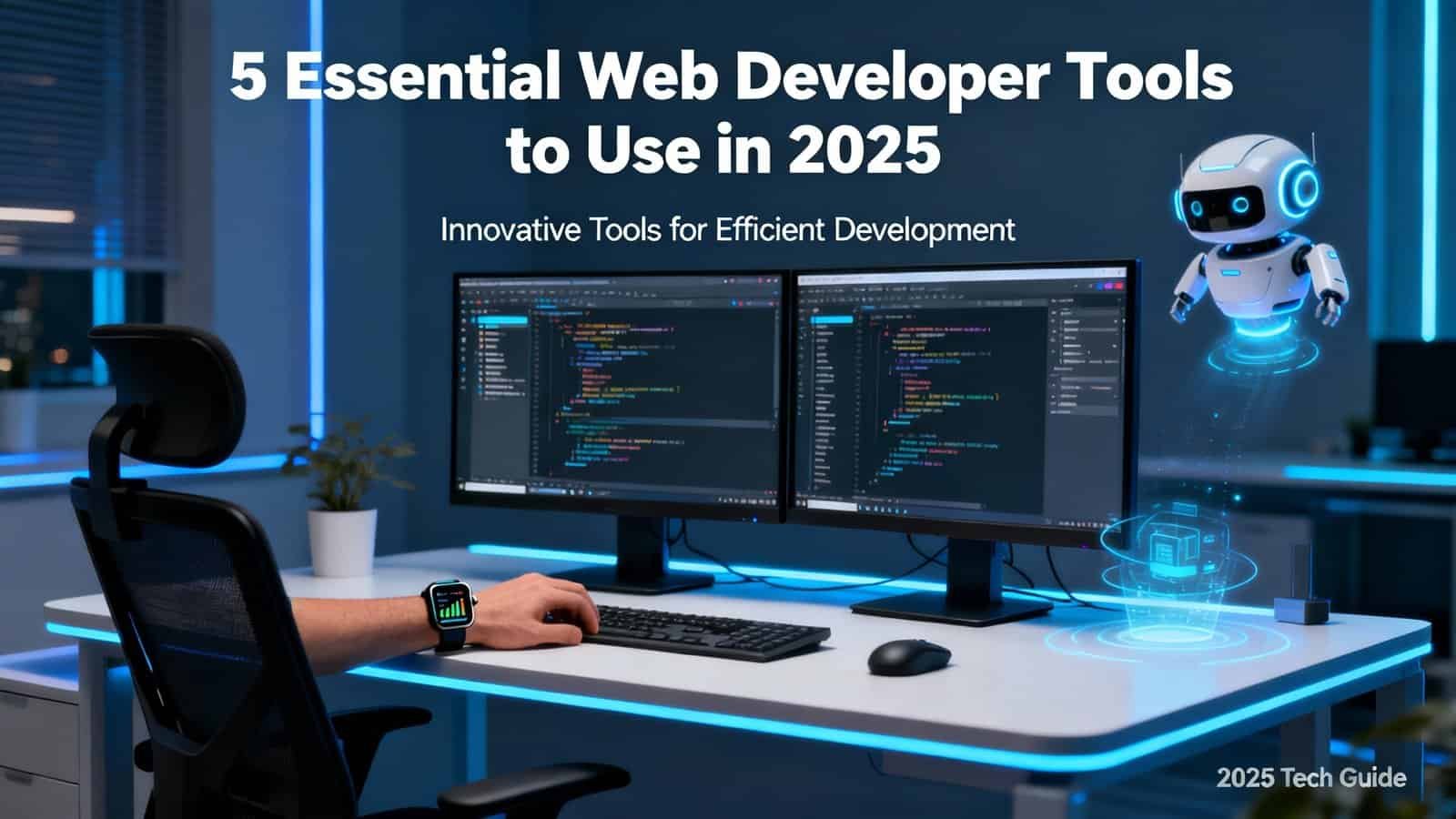
You’ll need Visual Studio Code with AI-powered extensions like GitHub Copilot for intelligent code generation and contextual completions. Vite transforms your development workflow with sub-second server starts and instant hot module reloading. Copilot acts as your pair-programming partner, generating entire functions while understanding project context. Vercel delivers zero-configuration deployments with edge optimization and real-time analytics. Chrome DevTools‘ advanced debugging features include breakpoint visualization and network time travel for performance profiling. These tools create an integrated ecosystem that anticipates your needs and addresses the strategic challenges ahead.
Key Takeaways
- Visual Studio Code with AI extensions like GitHub Copilot creates an intelligent coding environment that accelerates development timelines.
- Vite provides lightning-fast development with instant server startup and sub-100ms hot module reloading for modern web applications.
- GitHub Copilot acts as an AI pair-programming partner, generating contextual code completions and documentation across multiple languages.
- Vercel offers zero-configuration deployments with edge network optimization and automatic scaling for seamless production environments.
- Chrome DevTools delivers advanced debugging capabilities with breakpoint visualization, network time travel, and real-time performance profiling.
Visual Studio Code With Ai-Powered Extensions
Visual Studio Code has evolved into the cornerstone editor for modern web development, and AI-powered extensions are transforming how you’ll write, debug, and optimize code in 2025.
AI-powered VS Code extensions are revolutionizing development workflows, making 2025 the year of intelligent coding assistance.
GitHub Copilot and Tabnine lead the AI extensions revolution, offering intelligent code completion that understands context across multiple languages and frameworks. These tools don’t just autocomplete—they generate entire functions, suggest optimal algorithms, and even write unit tests based on your implementation patterns.
CodeGPT and ChatGPT extensions integrate conversational AI directly into your workflow, enabling real-time code explanations, refactoring suggestions, and architectural guidance without leaving your editor.
Workspace syncing capabilities guarantee your AI-customized environment follows you across devices. Settings Sync automatically transfers your extension configurations, keybindings, and AI model preferences between machines.
The strategic advantage lies in combining multiple AI extensions: use Copilot for code generation, Error Lens for real-time debugging insights, and GitLens for intelligent version control analysis. This ecosystem creates an integrated development environment that anticipates your needs and accelerates delivery timelines markedly.
Vite for Lightning-Fast Development and Build Processes
Breaking away from traditional bundlers like Webpack, Vite has emerged as the game-changing build tool that’s redefining development velocity in 2025. You’ll experience instant server startup and near-instantaneous hot module reloading that transforms your development workflow.
Vite leverages native ES modules during development, eliminating cold-start delays that plague traditional bundlers. When you modify components, changes reflect immediately without losing application state. The plugin ecosystem extends functionality seamlessly, offering React, Vue, and TypeScript integrations out-of-the-box.
| Feature | Traditional Bundlers | Vite |
|---|---|---|
| Server Start Time | 30-60 seconds | <1 second |
| HMR Speed | 2-5 seconds | <100ms |
| Build Optimization | Complex configuration | Zero-config defaults |
Production builds utilize Rollup for peak code splitting and tree-shaking. You’ll configure minimal settings while achieving maximum performance. Vite’s strategic advantage lies in its development-production parity, ensuring consistent behavior across environments while maintaining blazing-fast iteration cycles.
GitHub Copilot for Intelligent Code Generation
GitHub Copilot has stepped up as the definitive AI-powered coding assistant, fundamentally transforming how developers approach code creation and problem-solving in 2025.


You’re essentially gaining a sophisticated pair programming partner that understands context, suggests entire functions, and accelerates development workflows significantly.
The strategic advantages you’ll experience include:
- Contextual Code Completion – Copilot analyzes your project structure and coding patterns to generate relevant suggestions that align with your existing codebase architecture.
- Multi-Language Proficiency – You can seamlessly switch between JavaScript, Python, TypeScript, and dozens of other languages while maintaining consistent code quality and style.
- Documentation Generation – The tool automatically creates extensive comments and documentation, reducing technical debt and improving code maintainability.
However, ethical considerations around code ownership, licensing compliance, and dependency on AI-generated solutions require careful evaluation.
You’ll need to balance productivity gains with code review practices and maintain your fundamental programming skills.
Vercel for Seamless Deployment and Performance Optimization
Vercel has emerged as the deployment platform that streamlines your entire development-to-production pipeline, delivering unprecedented performance optimization through its edge network and serverless architecture. You’ll deploy applications instantly with automatic scaling, zero-configuration deployments, and built-in CI/CD workflows that eliminate traditional DevOps complexities.
Vercel transforms your deployment workflow with instant scaling, zero-configuration setups, and automated CI/CD pipelines that eliminate DevOps overhead entirely.
The platform’s edge functions enable you to run server-side logic globally, reducing latency by executing code closer to your users. You’re no longer constrained by single-region deployments or cold start penalties that plague traditional serverless solutions.
Vercel’s automatic image optimization transforms your media delivery strategy, compressing and serving images in next-generation formats based on device capabilities and network conditions. You’ll see significant performance improvements without manual intervention.
The analytics dashboard provides real-time insights into Core Web Vitals, enabling data-driven optimization decisions. Integration with popular frameworks like Next.js, React, and Vue.js guarantees seamless workflows, while preview deployments accelerate collaboration and testing cycles across your development team.
Chrome Devtools With Advanced Debugging Features
While deployment platforms handle your production environment, the real development magic happens in your browser’s debugging environment. Chrome DevTools has evolved into a powerhouse debugging suite that’ll transform how you diagnose and optimize your applications in 2025.
The latest DevTools features give you unprecedented visibility into your code’s execution and performance bottlenecks:

- Enhanced Breakpoint Visualizer – Interactive breakpoint mapping shows you exactly where your code pauses, with visual indicators for conditional breakpoints and logpoints across your entire codebase.
- Network Time Travel – Record and replay network requests to debug API interactions, simulate different connection speeds, and analyze request timing with frame-by-frame precision.
- Advanced Performance Profiling – Real-time CPU and memory analysis with flame graphs that pinpoint performance issues down to individual function calls.
These tools enable you to debug complex applications faster, identify performance regressions before they reach production, and maintain code quality standards.
Frequently Asked Questions
What’s the Average Cost of Premium Web Developer Tools in 2025?
You’ll find average pricing for premium web developer tools ranges from $10-50 monthly per user in 2025.
Most platforms offer subscription tiers starting with basic plans around $15/month, scaling to enterprise solutions exceeding $100/month.
You’re looking at roughly $300-600 annually for essential toolsets including IDEs, deployment platforms, and monitoring services.
Strategic bundling across multiple subscription tiers often reduces your overall costs considerably.
How Do I Backup and Sync My Development Environment Across Devices?
You’ll want to implement dotfiles sync using Git repositories to version-control your configuration files across machines.
Create workspace snapshots through containerization with Docker or development environments like Dev Containers.
Use cloud-based IDEs such as GitHub Codespaces or GitPod for instant synchronization.
Additionally, leverage shell configuration managers like Oh My Zsh with synchronized plugins, and maintain separate repositories for project-specific settings to guarantee consistent development environments everywhere.
Which Tools Work Best for Mobile-First Responsive Design Testing?
You’ll want Chrome DevTools for thorough device emulation and network throttling capabilities.
BrowserStack provides real device testing across multiple platforms, while Responsively App offers synchronized testing across viewports.
For touch gestures, use Firefox’s responsive design mode or physical devices.
Implement progressive enhancement by testing core functionality first, then layering advanced features.
These tools guarantee your mobile-first approach delivers consistent experiences across all breakpoints and connection speeds.
What Are the Top Browser Compatibility Testing Tools for 2025?
You’ll want BrowserStack for thorough cross browser testing with real device access, Playwright for automated rendering across multiple engines, and LambdaTest for cloud-based legacy emulation.
Integrate axe-core for accessibility auditing within your CI/CD pipeline.
These tools provide strategic coverage from modern browsers to legacy IE versions, ensuring your applications perform consistently across all user environments while maintaining accessibility standards.
How Do I Manage API Keys and Environment Variables Securely?
You’ll want to implement environment-specific configuration files with encrypted storage for production secrets. Use tools like HashiCorp Vault or AWS Secrets Manager for vault integration, enabling automated secrets rotation every 30-90 days.
Never commit keys to version control—leverage .env files locally and CI/CD variables for deployment. Implement least-privilege access controls and audit logs to track secret usage across your development pipeline.
Conclusion
You’ll maximize your development efficiency by integrating these five tools into your 2025 workflow. VS Code’s AI extensions will accelerate your coding velocity, while Vite’s build optimization reduces iteration cycles. GitHub Copilot’s intelligent suggestions enhance code quality and speed. Vercel’s deployment pipeline streamlines your production releases with built-in performance monitoring. Chrome DevTools‘ advanced debugging capabilities guarantee you’re identifying bottlenecks quickly. Adopting this tech stack positions you competitively in today’s rapid development landscape.
Table of Contents
- 1 Key Takeaways
- 2 Visual Studio Code With Ai-Powered Extensions
- 3 Vite for Lightning-Fast Development and Build Processes
- 4 GitHub Copilot for Intelligent Code Generation
- 5 Vercel for Seamless Deployment and Performance Optimization
- 6 Chrome Devtools With Advanced Debugging Features
- 7 Frequently Asked Questions
- 7.1 What’s the Average Cost of Premium Web Developer Tools in 2025?
- 7.2 How Do I Backup and Sync My Development Environment Across Devices?
- 7.3 Which Tools Work Best for Mobile-First Responsive Design Testing?
- 7.4 What Are the Top Browser Compatibility Testing Tools for 2025?
- 7.5 How Do I Manage API Keys and Environment Variables Securely?
- 8 Conclusion







No Comments