
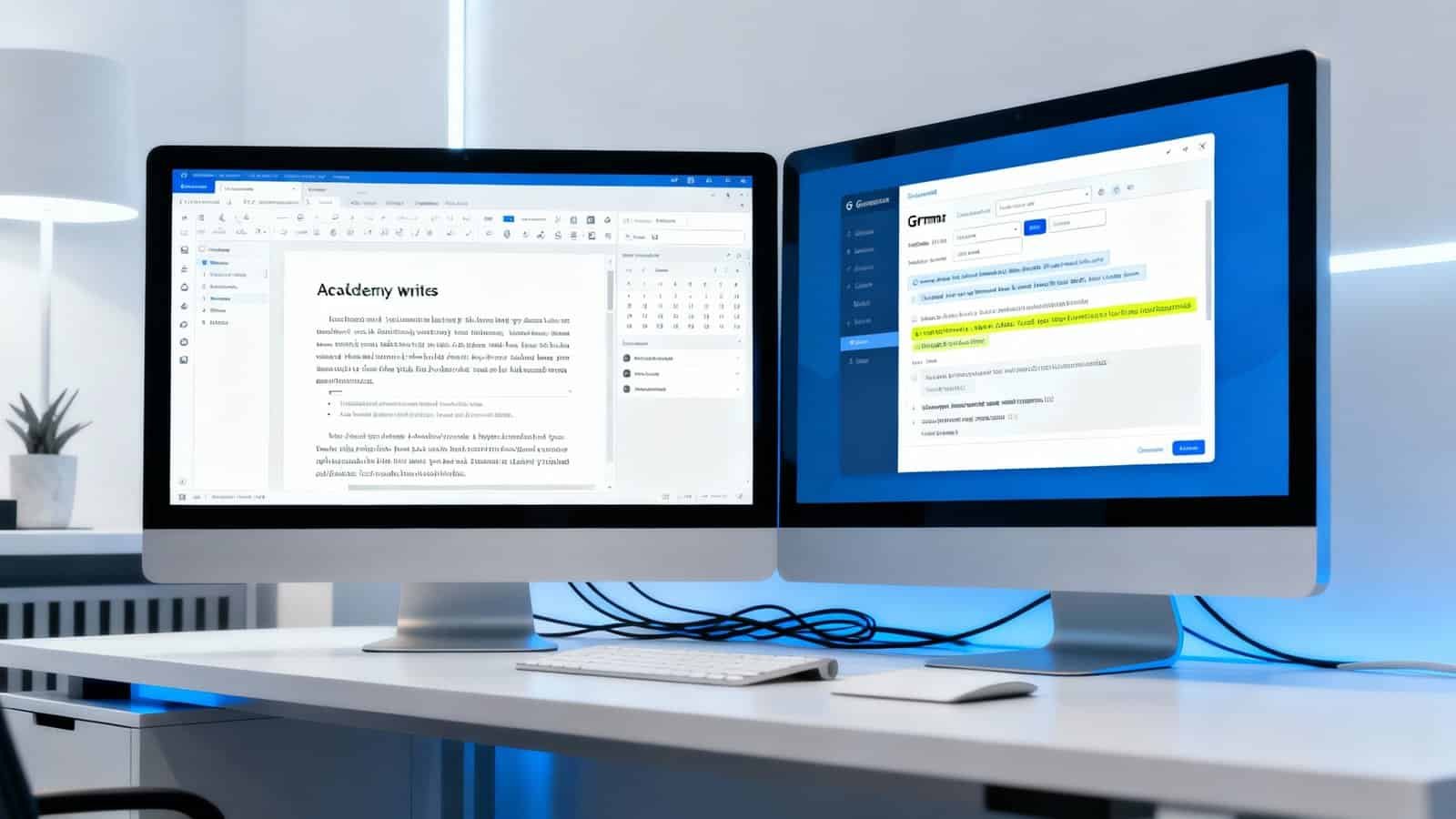
You’ll find that AI-powered grammar checkers analyze your academic writing through machine learning algorithms trained on millions of scholarly texts, delivering contextual corrections that traditional rule-based systems miss entirely. These tools validate citation formatting across APA, MLA, and Chicago styles while detecting plagiarism through semantic similarity analysis. They’ll also assess discipline-specific terminology accuracy and strengthen argument coherence through logical gap detection. Advanced implementations offer real-time integration with reference managers and provide algorithmic feedback that adapts to your field’s conventions.
Key Takeaways
- AI grammar checkers use machine learning to understand context and nuance, detecting subtle errors that traditional rule-based systems miss.
- Essential features include real-time plagiarism detection, comprehensive citation management, and formatting validation across APA, MLA, and Chicago styles.
- Advanced tools validate field-specific terminology against discipline databases and adapt recommendations based on academic context and writing genre.
- Integration with reference managers like Zotero and EndNote enables synchronized workflows with real-time bibliography validation and metadata preservation.
- Cloud-based processing raises privacy concerns for sensitive research content, requiring assessment of encryption standards and data storage policies.
How Ai-Powered Grammar Checkers Differ From Traditional Tools
While traditional grammar checkers rely on static rule-based algorithms that match text against predetermined patterns, AI-powered systems employ machine learning models trained on vast datasets to understand context, nuance, and semantic relationships.
You’ll notice AI checkers analyze sentence structure beyond surface-level pattern matching, enabling them to detect subtle errors that rule-based systems miss.
Traditional tools apply fixed grammatical rules uniformly, while AI systems adapt recommendations based on writing context and academic discipline. This contextual understanding allows AI to distinguish between acceptable informal usage and academic standards, providing more precise feedback for scholarly writing.
However, you should consider privacy concerns when using cloud-based AI checkers. Traditional offline tools process your text locally, while AI systems often transmit your content to remote servers for analysis. This data transmission raises confidentiality issues for sensitive academic research.
AI checkers also offer real-time learning capabilities, continuously improving through user interactions and expanding datasets.
Essential Features to Look for in Academic Writing Assistants
When selecting an academic writing assistant, you must prioritize tools that integrate thorough citation management systems capable of formatting references across multiple academic styles including APA, MLA, and Chicago.
Your chosen platform should incorporate real-time plagiarism detection algorithms that scan against extensive academic databases and web sources to identify potential intellectual property violations. These two core functionalities form the foundation of any robust academic writing tool, as citation errors and undetected plagiarism can compromise your scholarly credibility and academic standing.
Citation Format Accuracy
Precision in citation formatting determines the credibility and professional standing of your academic work.
You’ll need software that validates reference punctuation across multiple style guides—APA, MLA, Chicago, and IEEE—with algorithmic accuracy.


Advanced checkers analyze in text parentheses placement, author-date sequences, and page number formatting against database rules.
Look for tools that detect inconsistencies between your bibliography and in-text citations.
The software should flag missing elements: publication years, page ranges, or publisher information.
Machine learning algorithms now identify subtle formatting errors that manual proofreading often misses.
Your chosen assistant must handle diverse source types: journal articles, books, websites, and conference proceedings.
Real-time validation prevents citation errors before submission, ensuring your research meets institutional standards and maintains academic integrity throughout the writing process.
Plagiarism Detection Capabilities
Because academic integrity forms the foundation of scholarly work, your writing assistant must incorporate sophisticated plagiarism detection algorithms that scan against extensive databases.
Advanced systems employ machine learning models that identify paraphrasing patterns and semantic similarities beyond simple text matching.
Essential plagiarism detection capabilities include:
- Real-time scanning against academic journals, web content, and institutional repositories
- Authorship attribution analysis using stylometric fingerprinting to detect ghostwriting patterns
- Cross language detection algorithms that identify translated plagiarism across multiple languages
- Similarity threshold customization allowing adjustable sensitivity levels for different academic contexts
Your chosen tool should provide detailed similarity reports with source attribution, percentage matches, and contextual highlighting. These features guarantee thorough academic integrity verification while supporting transparent scholarly communication standards.

Top AI Grammar and Style Checkers for Scholarly Content
How do you identify the most effective AI-powered grammar and style checkers that meet the rigorous demands of scholarly writing?
You’ll need to evaluate tools through systematic assessment of their algorithmic capabilities and empirical performance metrics.
Grammarly Premium delivers advanced contextual analysis with sophisticated syntax detection, though its pricing comparison reveals higher costs than competitors.
ProWritingAid offers in-depth style analysis with detailed reporting mechanisms.
Turnitin’s Revision Assistant integrates seamlessly with academic workflows.
LanguageTool provides open-source flexibility with customizable rule sets for discipline-specific requirements.
Critical evaluation factors include accuracy rates for complex sentence structures, citation format recognition, and terminology databases.
You must assess data privacy protocols, particularly encryption standards and storage policies, since academic content often contains sensitive research information.
Each platform’s machine learning algorithms demonstrate varying proficiency levels across different writing genres.
Performance benchmarks should focus on false positive rates, processing speed, and integration compatibility with academic publishing platforms.

Integrating Citation Management With Grammar Checking Tools
While evaluating grammar checkers based on performance metrics provides foundational selection criteria,
you’ll maximize research efficiency by examining how these tools synchronize with citation management systems.
Modern academic workflows demand seamless API integration between grammar checkers and reference managers like Zotero, Mendeley, or EndNote.
Strategic implementation involves these core considerations:
- Real-time bibliography validation – Configure automated cross-referencing between in-text citations and reference lists during grammar analysis
- Metadata preservation – Guarantee formatting corrections don’t corrupt embedded citation data or DOI links
- Version control synchronization – Maintain citation accuracy across collaborative editing sessions with tracked changes
- Custom style guide enforcement – Program discipline-specific citation formats alongside grammatical rules
You’ll achieve ideal sync workflows by selecting grammar checkers that offer native plugin support for your preferred citation manager.
This integration eliminates manual verification steps while preserving citation integrity throughout iterative editing processes, reducing publication delays caused by formatting inconsistencies.
Discipline-Specific Writing Support and Terminology Validation
You’ll need specialized validation algorithms that verify field-specific terminology against discipline-specific databases to guarantee accuracy in technical nomenclature, chemical formulas, and specialized jargon.
Your grammar checker must enforce citation format compliance by cross-referencing style guides like APA, MLA, or Chicago against your document’s formatting patterns.
You can’t rely on generic writing rules when disciplinary conventions dictate specific syntactic structures, passive voice preferences, and methodological reporting standards that vary across academic fields.
Field-Specific Vocabulary Accuracy
When your research spans specialized domains, maintaining terminological precision becomes critical for establishing credibility and ensuring accurate knowledge transfer.
AI-powered checkers must process rapidly evolving technical vocabularies while performing contextual disambiguation across overlapping fields.
Advanced systems implement four core mechanisms for field-specific accuracy:
- Dynamic lexicon updates that track terminology evolution in real-time through peer-reviewed publications
- Semantic clustering algorithms that distinguish between homonyms across different disciplines
- Context-aware validation that analyzes surrounding text to determine appropriate technical usage
- Cross-referential verification against authoritative domain-specific databases and style guides
These capabilities enable you to navigate complex terminological landscapes where identical terms carry distinct meanings.
The system’s contextual disambiguation prevents misapplication of terminology while ensuring your writing adheres to established conventions within your specific academic field.
Citation Format Compliance
As citation requirements vary dramatically across academic disciplines, maintaining format compliance demands sophisticated pattern recognition systems that adapt to multiple style frameworks simultaneously.
You’ll need algorithms that parse bibliographic elements—author sequences, publication dates, volume numbers—then reconstruct them according to discipline-specific protocols.
The system must validate punctuation placement, italicization patterns, and hanging indent specifications across APA, MLA, Chicago, and IEEE formats.
Citation provenance tracking guarantees you’re maintaining accurate source hierarchies while monitoring version control across draft iterations.
Advanced checkers integrate accessibility tagging protocols, embedding metadata that supports screen readers and alternative text descriptions for citations containing special characters or mathematical notation.
Real-time validation prevents format drift during collaborative editing sessions.
Disciplinary Writing Conventions
Beyond citation mechanics, grammar checkers must recognize that each academic discipline operates within distinct linguistic ecosystems with specialized terminology, syntactic preferences, and rhetorical conventions.
You’ll need systems that adapt to discipline-specific requirements and validate domain-appropriate language choices.
Effective disciplinary writing support requires algorithmic recognition of:
- Terminological accuracy – Validating field-specific vocabulary and identifying inappropriate substitutions
- Syntactic patterns – Recognizing discipline-preferred sentence structures and voice conventions
- Genre expectations – Detecting format deviations in lab reports, theoretical analyses, or case studies
- Audience positioning – Analyzing register appropriateness for peer review versus general academic contexts
Your checker must differentiate between STEM’s passive constructions and humanities’ active voice preferences.
Machine learning models trained on disciplinary corpora can identify contextual appropriateness, ensuring your writing aligns with field-specific standards while maintaining grammatical precision.
Improving Argument Structure and Coherence With AI Feedback
While traditional grammar checkers identify surface-level errors, AI-powered writing assistants now analyze the logical flow and structural integrity of your academic arguments. These systems perform assumption tracing to map implicit premises and identify gaps in your reasoning chain. They’ll flag when you’ve made unsupported leaps or failed to establish necessary groundwork for subsequent claims.
AI feedback also evaluates rhetorical scaffolding—the framework supporting your argument’s progression. The technology examines transitional quality, evidence placement, and counterargument integration to strengthen your persuasive structure.
| Analysis Component | AI Detection Method | Output Recommendation |
|---|---|---|
| Logical gaps | Premise-conclusion mapping | Insert bridging statements |
| Weak linkages | Semantic coherence scoring | Strengthen connective phrases |
| Evidence placement | Citation-claim proximity analysis | Reposition supporting data |
| Counterargument integration | Opposition detection algorithms | Add refutation sections |
| Conclusion alignment | Thesis-summary correspondence | Revise closing arguments |
You’ll receive targeted suggestions for reorganizing paragraphs, strengthening causal relationships, and eliminating circular reasoning patterns that undermine scholarly credibility.
Maintaining Academic Voice While Enhancing Readability
Academic writing tools must navigate the tension between scholarly rigor and accessible communication, requiring sophisticated algorithms that preserve disciplinary conventions while eliminating unnecessary complexity.
Tone calibration algorithms analyze lexical density, sentence complexity metrics, and disciplinary terminology frequency to maintain appropriate academic register while improving comprehension.
You’ll find these systems employ natural language processing models trained on discipline-specific corpora to distinguish between necessary technical precision and gratuitous verbosity.
These sophisticated algorithms differentiate between essential academic terminology and unnecessarily complex language through specialized corpus training.
Register preservation mechanisms guarantee you retain field-appropriate conventions through:
- Hedging language detection – Preserving epistemic modality markers essential for academic discourse
- Nominalization optimization – Reducing excessive noun phrases while maintaining conceptual precision
- Citation integration analysis – Guaranteeing source incorporation doesn’t compromise voice consistency
- Passive voice contextualization – Identifying instances where passive construction serves methodological clarity
These AI systems continuously refine recommendations through corpus analysis, measuring readability improvements against academic authenticity scores.
You’ll achieve enhanced accessibility without sacrificing the intellectual rigor your discipline demands.
Best Practices for Maximizing AI Writing Tool Effectiveness
Strategic implementation of AI writing tools requires systematic configuration and iterative refinement to achieve peak performance metrics.
You’ll optimize results by establishing clear parameters before processing your documents. Configure privacy settings to guarantee institutional compliance while maintaining data security protocols.
Create a structured feedback loop by analyzing suggested revisions against your intended academic outcomes. Document which recommendations enhance clarity without compromising scholarly rigor.
You’ll identify patterns in the AI’s strengths and limitations through systematic evaluation.
Train the system by accepting accurate suggestions and rejecting inappropriate ones. This iterative process calibrates the tool to your specific writing style and disciplinary requirements.
Monitor correction frequency to gauge improvement trends.
Implement version control by saving drafts at each revision stage. You’ll track enhancement progression and identify most effective intervention points.
Set processing parameters for your target audience’s comprehension level while preserving academic authenticity. Regular performance assessment guarantees sustained effectiveness across diverse writing projects.
Frequently Asked Questions
Can AI Grammar Checkers Detect Plagiarism in Academic Papers?
Most AI grammar checkers can’t effectively detect plagiarism in your academic papers. You’ll need specialized plagiarism detection software that employs paraphrase recognition algorithms and maintains extensive databases for source attribution verification.
Grammar checkers focus on linguistic correctness rather than content originality analysis. They lack the computational frameworks necessary to cross-reference your text against millions of published sources and identify semantic similarities indicative of academic misconduct.
Are AI Writing Tools Allowed During Standardized Academic Exams?
You can’t use AI writing tools during standardized academic exams, as they’re strictly prohibited by testing protocols.
Exam administrators implement controlled environments that block external assistive technology to safeguard assessment integrity.
You’ll need to rely on manual time management strategies and your own writing capabilities.
Proctoring systems actively monitor for unauthorized digital assistance, and violations result in immediate disqualification with documented academic penalties.
Do Universities Have Policies Against Using AI Grammar Checkers?
You’ll find policy variation across institutions regarding AI grammar checkers.
Most universities don’t explicitly prohibit grammar-checking tools, distinguishing them from content generation AI.
However, you should verify your institution’s specific guidelines, as policies evolve rapidly.
Privacy concerns emerge when you upload academic work to third-party platforms.
You’re typically safer using offline grammar tools or university-approved software that doesn’t store your data externally.
Will Using AI Tools Affect My Academic Integrity Standing?
Using AI tools won’t affect your academic integrity standing if you follow institutional consent protocols and adhere to transparency norms.
You must disclose AI assistance when required by your university’s policies.
Academic integrity violations occur when you misrepresent AI-generated content as original work or use prohibited tools.
Check your institution’s specific guidelines, as policies vary substantially.
Proper disclosure and compliance with established frameworks maintain your ethical standing while leveraging technological assistance.
Can Professors Detect When Students Use AI Grammar Assistance?
Detection depends on linguistic fingerprints AI tools leave in your text. Most professors can’t identify grammar assistance specifically since these tools preserve your original voice while correcting syntax.
However, instructor perception may flag sudden improvement in writing quality or uncharacteristic error patterns. You’re generally safe using grammar checkers as they function like advanced spell-check rather than content generation, making detection nearly impossible through standard plagiarism software.
Conclusion
You’ll optimize your academic writing efficiency by systematically implementing AI grammar checkers that process syntax, semantics, and discourse-level patterns. Integrate these tools with your citation workflows, configure discipline-specific parameters, and leverage algorithmic feedback for structural coherence. Don’t compromise your scholarly voice—instead, calibrate readability metrics while maintaining academic rigor. Execute iterative revisions based on empirical performance data from these systems. Your writing quality will improve measurably when you consistently apply these evidence-based optimization strategies.
Table of Contents
- 1 Key Takeaways
- 2 How Ai-Powered Grammar Checkers Differ From Traditional Tools
- 3 Essential Features to Look for in Academic Writing Assistants
- 4 Top AI Grammar and Style Checkers for Scholarly Content
- 5 Integrating Citation Management With Grammar Checking Tools
- 6 Discipline-Specific Writing Support and Terminology Validation
- 7 Improving Argument Structure and Coherence With AI Feedback
- 8 Maintaining Academic Voice While Enhancing Readability
- 9 Best Practices for Maximizing AI Writing Tool Effectiveness
- 10 Frequently Asked Questions
- 10.1 Can AI Grammar Checkers Detect Plagiarism in Academic Papers?
- 10.2 Are AI Writing Tools Allowed During Standardized Academic Exams?
- 10.3 Do Universities Have Policies Against Using AI Grammar Checkers?
- 10.4 Will Using AI Tools Affect My Academic Integrity Standing?
- 10.5 Can Professors Detect When Students Use AI Grammar Assistance?
- 11 Conclusion








No Comments