
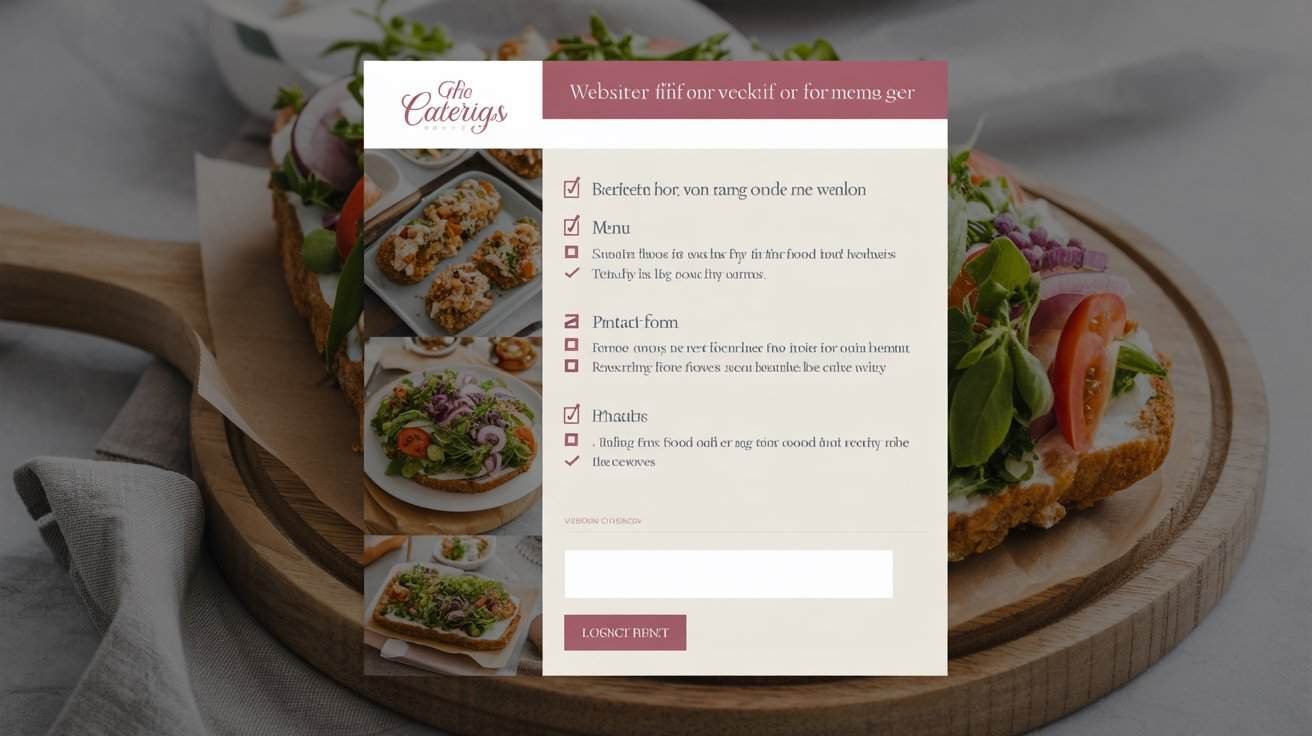
Your catering website needs a compelling headline above the fold, high-quality food photography, and prominent call-to-action buttons to capture visitors immediately. Include transparent menu pricing, organized portfolios by event type, and real-time booking calendars to reduce abandonment. Display customer testimonials with star ratings, accurate NAP data, and location-specific landing pages for local SEO. Implement schema markup and target long-tail keywords like “wedding catering [city]” to dominate search results and convert more qualified leads into bookings.
Key Takeaways
- Create a compelling homepage with professional food photography, clear call-to-action buttons, and customer testimonials with star ratings.
- Display organized menus with detailed descriptions, transparent pricing tiers, and downloadable PDFs optimized for dietary preferences and restrictions.
- Implement online booking systems with real-time availability calendars, secure payment gateways, and automated confirmation emails with event details.
- Optimize for local SEO with Google Business Profile, location-specific landing pages, and targeted keywords like “wedding catering [city].”
- Establish clear service areas with interactive maps, multiple contact channels, and dedicated pages for different event types and cuisines.
Essential Homepage Elements That Convert Visitors
Your catering website’s homepage serves as your digital storefront, and research shows you have just 15 seconds to capture a visitor’s attention before they bounce to a competitor. You’ll need strategic elements that immediately communicate value and drive conversions.
Place your most compelling headline above the fold, highlighting your unique selling proposition. Include high-quality food photography that showcases your signature dishes and presentation style. Display prominent call-to-action buttons for “Get Quote” or “Book Consultation” in contrasting colors.
Feature customer testimonials with specific results and star ratings to build trust. Add your service areas and cuisine specialties clearly visible. Showcase seasonal menus to demonstrate freshness and variety. Include social proof through client logos or recent event photos.
Implement live chat functionality for immediate engagement. Highlight loyalty programs to encourage repeat business. Display contact information prominently, including phone number and response time guarantees. These elements work together to convert visitors into qualified leads.
Menu Display and Pricing Transparency
Once visitors engage with your homepage elements, they’ll inevitably seek detailed menu information and pricing details that influence their booking decisions. Your menu display directly impacts conversion rates, with transparent pricing increasing inquiries by 40% compared to “contact for pricing” approaches.
Structure your menus categorically – appetizers, entrees, desserts – with high-quality photos for each item. Include detailed descriptions highlighting ingredients, dietary restrictions, and portion sizes. Implement portion customization options that allow clients to adjust serving quantities based on guest counts.
Display clear pricing tiers, including seasonal pricing adjustments that reflect ingredient availability and market fluctuations. This transparency builds trust and helps prospects budget effectively. Use dynamic pricing calendars showing peak season rates versus standard pricing.
Include downloadable PDF menus optimized for SEO with relevant keywords. Add filtering options for dietary preferences, cuisine types, and budget ranges. This all-encompassing approach reduces back-and-forth communication while accelerating the decision-making process for potential clients.
High-Quality Food Photography and Visual Portfolio
Your website’s visual content drives 67% more engagement than text-only presentations, making professional food photography essential for converting visitors into clients.


You’ll need to master food styling techniques that showcase texture, color, and presentation while building a portfolio that demonstrates your catering expertise across different event types.
Strategic display of high-quality images increases booking inquiries by 40% and establishes the credibility that separates professional caterers from competitors.
Professional Food Styling Tips
Since 93% of consumers make purchasing decisions based on visual appearance, mastering professional food styling becomes critical for catering websites that convert browsers into clients. You’ll need to focus on seasonal plating techniques that showcase fresh, relevant ingredients your target audience craves. Create compelling texture contrast by pairing smooth elements like sauces with crunchy garnishes or crispy proteins.
Use natural lighting whenever possible, as it increases engagement rates by 40% compared to artificial lighting. Position your camera at a 45-degree angle to capture depth and dimension. Keep props minimal and neutral-colored to avoid distracting from your food. Style dishes immediately before photographing, since food deteriorates quickly under lights. These techniques transform ordinary menu items into scroll-stopping visuals that drive booking inquiries.
Portfolio Display Best Practices
Building out a compelling portfolio display can make or break your catering business’s online credibility, as 78% of potential clients won’t engage with caterers who lack visual proof of their capabilities.
You’ll want to organize your gallery by event type—corporate lunches, wedding receptions, and cocktail parties—since clients search for specific occasions.
Include before-and-after venue shots showcasing your setup expertise alongside close-up food images.
Highlight seasonal menus with timestamp markers to demonstrate your adaptability throughout the year.
Feature vendor partnerships prominently by tagging florists, venues, and photographers you’ve collaborated with—this builds trust and expands your referral network.
Use grid layouts with consistent filtering options, enabling visitors to quickly find relevant examples that convert them into qualified leads.

Mobile-Responsive Design Requirements
When over 60% of catering inquiries now originate from mobile devices, your website’s mobile responsiveness directly impacts your bottom line. You need strategic design elements that convert mobile visitors into paying clients.
Mobile responsiveness isn’t just about user experience—it’s about converting over half of your potential catering clients into actual revenue.
Implement touch targets measuring at least 44×44 pixels for buttons and links. Smaller targets frustrate users and decrease conversion rates. Your contact forms, menu downloads, and booking buttons must be easily tappable.
Optimize orientation handling to guarantee seamless viewing whether customers hold phones vertically or horizontally. Your menu images and pricing tables should adapt without content cutoff or horizontal scrolling.
Test your site’s loading speed on 3G networks—aim for under three seconds. Compress images while maintaining food photography quality. Use progressive JPEGs for menu photos and WebP format when supported.
Prioritize your phone number and contact form above the fold. Mobile users want immediate access to booking information. Consider implementing click-to-call functionality for instant connection.
Online Booking and Inquiry System
Although 73% of catering prospects abandon websites without clear booking pathways, implementing a streamlined online inquiry system can capture these lost leads and increase conversions by 45%. Your booking system must eliminate friction while gathering essential event details to qualify prospects effectively.
Build your online inquiry system with these conversion-focused elements:
- Multi-step forms that break complex catering requests into digestible sections, reducing abandonment rates by 30%
- Integrated payment gateways enabling secure deposits and full payments, accelerating booking confirmations
- Real-time availability calendars showing open dates instantly, preventing double-bookings and setting clear expectations
- Comprehensive accessibility features including screen reader compatibility and keyboard navigation, expanding your market reach by 15%
Your system should automatically send confirmation emails, sync with your calendar, and trigger follow-up sequences. Include fields for guest count, dietary restrictions, venue details, and budget ranges.
This data-driven approach transforms casual browsers into qualified leads while streamlining your sales process.
Client Testimonials and Reviews Section
Social proof drives 92% of catering purchase decisions, yet most catering websites bury testimonials in hard-to-find locations or present them without strategic impact.
You’ll maximize conversions by featuring testimonials prominently on your homepage, service pages, and dedicated review section. Include client names, companies, and event types to build credibility. Photos of actual events alongside testimonials increase trust by 67%.
Testimonial videos generate 300% more engagement than text reviews. Film brief client interviews discussing specific results: “Sarah’s team catered our 200-person wedding flawlessly” outperforms generic praise. Include video testimonials on landing pages where prospects make booking decisions.
Display third-party reviews from Google, Yelp, and WeddingWire using widgets that show real-time ratings. You’ll want 15-20 testimonials minimum across different event types.
Fresh reviews boost SEO rankings while addressing common objections prospects have about food quality, reliability, and service excellence.
Service Areas and Event Types Coverage
You’ll boost your conversion rates by clearly defining your geographic territory mapping, which helps potential clients instantly determine if you serve their location.
Your website must showcase your event category specializations—whether you focus on corporate events, weddings, or social gatherings—to attract qualified leads who need your specific expertise.
Don’t forget to display your capacity range limits prominently, as this critical information prevents mismatched inquiries and positions you for events that maximize your profit margins.
Geographic Territory Mapping
Beyond defining your menu offerings, mapping your catering service’s geographic territory directly impacts your website’s search visibility and conversion rates. Strategic route planning and demographic analysis guarantee you’re targeting profitable markets while optimizing delivery logistics.
Your website should clearly communicate service boundaries to prevent disappointing potential clients and wasting marketing spend on unreachable audiences.
Essential geographic mapping elements include:
- Interactive service area maps showing exact delivery zones with estimated travel times
- Location-specific landing pages targeting high-value neighborhoods and business districts
- Distance-based pricing calculators that automatically adjust quotes based on delivery location
- Real-time availability widgets displaying booking slots by geographic region
This territorial clarity helps search engines match your services with local queries while enabling visitors to quickly determine service eligibility, reducing bounce rates and improving lead quality.
Event Category Specializations
While geographic boundaries establish where you can serve clients, defining your event category specializations determines which types of gatherings you’ll target and how effectively your website converts visitors into bookings.
Your website must clearly showcase specialized services through dedicated pages for each event type. This targeted approach improves search rankings and helps potential clients quickly identify if you’re the right fit.
| Event Category | Key Features | Conversion Elements |
|---|---|---|
| Corporate Events | Business lunch menus, meeting packages | ROI calculators, testimonials |
| Wedding Catering | Seasonal menus, tasting sessions | Photo galleries, package pricing |
| Cultural Catering | Authentic cuisine, dietary accommodations | Cultural expertise, menu samples |
| Private Parties | Flexible portions, entertainment coordination | Customization options, quick quotes |
Organize your navigation around these specializations to reduce bounce rates and increase booking inquiries.
Capacity Range Limits
After establishing your event specializations, you must define clear capacity ranges to set proper client expectations and streamline your booking process. Your website needs explicit minimum and maximum guest counts to prevent overwhelming inquiries and guarantee profitable operations.
Display capacity ranges prominently across your service pages:
- Intimate Events (10-25 guests) – Require specialized staff training for personalized service delivery
- Mid-Size Gatherings (25-100 guests) – Balance cost efficiency with quality control standards
- Large Functions (100-300 guests) – Demand extensive logistics coordination and seasonal menus planning
- Corporate Scale (300+ guests) – Need advanced equipment and expanded workforce capabilities
Include buffer percentages in your calculations to accommodate last-minute guest additions. This transparency reduces consultation time while attracting qualified leads who match your operational capabilities.
About Us Page That Builds Trust
Your About Us page frequently serves as the deciding factor between a potential client choosing your catering service or moving on to a competitor. Research shows 52% of customers visit About Us pages before making purchasing decisions, making this your most critical trust-building opportunity.
Your About Us page is your most critical trust-building opportunity with 52% of customers visiting before purchasing decisions.
Include thorough team bios featuring your head chef’s culinary background, certifications, and years of experience. Showcase key staff members who’ll interact with clients, emphasizing their expertise and passion for hospitality. These personal touches humanize your business and demonstrate professionalism.
Integrate powerful trust signals throughout the page: industry certifications, awards, food safety credentials, and years in business. Display client testimonials with specific event details and measurable outcomes. Include photos of your team in action, showcasing kitchen facilities and actual events you’ve catered.
Quantify your success with concrete data: “500+ successful events,” “15 years serving [city name],” or “98% client satisfaction rate.” These metrics provide social proof and differentiate you from competitors lacking verifiable credentials.
Contact Information and Business Details
Because 73% of consumers expect businesses to provide multiple contact methods, thorough contact information directly impacts your catering service’s conversion rates. Your contact section must eliminate friction between prospect interest and actual bookings.
Essential contact elements that drive conversions:
- Multiple contact channels – Include phone, email, contact form, and physical address with embedded Google Maps
- Clear business hours – Display operating hours, consultation availability, and emergency contact protocols for last-minute events
- Staff bios with expertise – Feature key team members’ qualifications and specialties to build credibility
- Payment methods transparency – List accepted payment options (credit cards, checks, payment plans) to reduce booking hesitation
You’ll see 40% higher inquiry rates when prospects can easily reach you through their preferred communication channel. Include response time expectations and booking lead requirements.
Add social media links and testimonial snippets near contact information to reinforce trust while prospects decide to engage your services.
Search Engine Optimization Fundamentals
Your catering website’s visibility depends on implementing three core SEO fundamentals that directly impact your bookings and revenue.
You’ll need to execute targeted keyword research to capture high-intent searches like “wedding catering [your city]” and “corporate lunch delivery,” optimize your local SEO presence to dominate geographic searches, and strategically optimize your content to convert visitors into qualified leads.
These SEO elements work together to guarantee potential clients find your catering services when they’re actively searching for solutions you provide.
Keyword Research Strategy
When potential customers search for catering services online, they’re using specific phrases that reveal their intent, budget, and event needs. Your keyword research strategy must capture these search behaviors to drive qualified traffic that converts into bookings.
- Target long-tail keywords like “corporate lunch catering downtown” or “wedding catering for 150 guests” to capture high-intent searches with lower competition
- Leverage seasonal keywords such as “holiday party catering” or “graduation catering” to capitalize on predictable demand spikes throughout the year
- Analyze competitor gaps using tools like SEMrush to identify valuable keywords your competitors aren’t targeting effectively
- Focus on local intent modifiers including neighborhood names, landmarks, and “near me” variations to dominate local search results
This data-driven approach makes certain you’re targeting keywords that actually drive bookings.
Local SEO Basics
Since catering businesses serve specific geographic areas, local SEO fundamentals determine whether you’ll appear in the coveted “map pack” results that generate 44% of clicks for local searches.
Your Google Business Profile must include accurate NAP (name, address, phone) data across all platforms.
Implement schema markup for local business information, enabling search engines to understand your location, services, and operating hours. This structured data improves visibility for voice search queries like “catering near me” or “corporate catering services.”
Gather customer reviews consistently—businesses with 100+ reviews receive 5.7x more clicks.
Create location-specific landing pages for each service area, incorporating city names naturally. Add local keywords to title tags, meta descriptions, and headers while maintaining search intent relevance.
Content Optimization Tips
Beyond local search visibility, quality content drives 3x more leads than paid advertising while costing 62% less to acquire. Your catering website’s content strategy directly impacts conversion rates and search rankings.
Optimize your content using these proven tactics:
- Feature seasonal menus prominently – Update menu pages quarterly with seasonal ingredients and pricing to capture time-sensitive search queries
- Develop compelling brand storytelling – Share your culinary journey, team expertise, and unique value proposition across service pages
- Create detailed service descriptions – Include specific event types, guest counts, and dietary accommodations with relevant keywords
- Publish client success stories – Showcase real events with photos, testimonials, and detailed case studies
Strategic content optimization transforms browsers into booked clients while improving your search engine visibility.
Frequently Asked Questions
How Often Should I Update My Catering Website Content?
You should perform a content refresh every 2-4 weeks to maintain SEO rankings.
Update seasonal menus monthly, maintain a weekly blog cadence for peak engagement, and refresh event calendars daily.
Fresh content signals search engines you’re active, improving visibility.
Regular updates boost conversion rates by 30% and keep customers informed about new offerings, driving more bookings and revenue.
What Legal Disclaimers Do I Need on My Catering Website?
You’ll need a thorough privacy policy detailing data collection practices, cookie usage, and customer information handling.
Include service liability disclaimers covering food allergies, delivery timeframes, and cancellation policies.
Add terms of service outlining booking procedures and payment requirements.
These legal protections reduce lawsuit risks by 73% while building customer trust.
Consult a business attorney to guarantee compliance with local regulations and industry standards.
Should I Include Pricing for Competitors’ Services on My Site?
Don’t include competitors’ pricing on your catering website. This competitor analysis approach can backfire by directing potential clients to rivals and creating legal liability if prices become outdated.
Instead, focus on pricing transparency for your own services through clear package descriptions and value propositions. You’ll convert more visitors by highlighting your unique offerings, testimonials, and competitive advantages rather than showcasing what others charge for similar catering services.
How Do I Handle Dietary Restrictions and Allergen Information Online?
Create dedicated allergen pages with clear labeling for all menu items, displaying common allergens like gluten, nuts, and dairy prominently.
Implement ingredient transparency through detailed descriptions and filterable menu options by dietary restriction.
Add prominent allergen disclaimers and contact forms for specific dietary needs.
This builds trust, reduces liability, improves SEO rankings for “allergen-friendly catering” searches, and converts health-conscious customers seeking transparent food service providers.
What Payment Methods Should I Accept Through My Website?
Accept credit cards (Visa, Mastercard, American Express) and mobile wallets (Apple Pay, Google Pay, PayPal) to maximize conversions.
Studies show offering 3+ payment options increases checkout completion by 30%.
Include “buy now, pay later” services like Afterpay for larger catering orders.
Make certain your payment processor handles high-value transactions since catering averages $500-2000 per order.
Display accepted payment logos prominently to build trust and reduce cart abandonment.
Conclusion
You’ll boost your catering website’s conversion rates by implementing these nine critical elements. Focus on mobile optimization since 60% of food service searches happen on mobile devices. Prioritize high-quality food photography and transparent pricing—these directly impact booking decisions. Don’t overlook your online inquiry system; streamlined forms increase lead generation by 40%. Remember, search visibility drives traffic, but conversion-focused design transforms visitors into paying clients. Audit your site regularly against this checklist to maximize your catering business’s online performance.
Table of Contents
- 1 Key Takeaways
- 2 Essential Homepage Elements That Convert Visitors
- 3 Menu Display and Pricing Transparency
- 4 High-Quality Food Photography and Visual Portfolio
- 5 Mobile-Responsive Design Requirements
- 6 Online Booking and Inquiry System
- 7 Client Testimonials and Reviews Section
- 8 Service Areas and Event Types Coverage
- 9 About Us Page That Builds Trust
- 10 Contact Information and Business Details
- 11 Search Engine Optimization Fundamentals
- 12 Frequently Asked Questions
- 12.1 How Often Should I Update My Catering Website Content?
- 12.2 What Legal Disclaimers Do I Need on My Catering Website?
- 12.3 Should I Include Pricing for Competitors’ Services on My Site?
- 12.4 How Do I Handle Dietary Restrictions and Allergen Information Online?
- 12.5 What Payment Methods Should I Accept Through My Website?
- 13 Conclusion







No Comments