

You’ll get complete access to Shopify’s e-commerce platform for 14 days without upfront costs or feature restrictions. Your trial includes 100+ professional templates, unlimited product listings, payment gateway integration, abandoned cart recovery, and analytics dashboards. You can test all core features, including inventory management, SEO tools, and marketing automation, to evaluate business requirements. The setup process takes minutes, giving you immediate admin panel access to customize your store and monitor performance metrics for informed decision-making.
Key Takeaways
- Shopify offers a free trial with access to complete e-commerce tools, professional templates, and unlimited product listings without feature restrictions.
- Start your free trial by visiting Shopify’s homepage, entering your email, creating a password, and providing basic store information.
- Trial includes 100+ professional themes, payment gateway integration, inventory management tools, and customization options for store branding.
- Full access to marketing tools like email automation, SEO features, social media integration, and analytics dashboard during trial period.
- After trial ends, choose from three paid plans: Basic ($39), Shopify ($105), or Advanced ($399) with varying transaction fees.
What You Get During Your Trial Period

When you activate your Shopify free trial, you’ll gain immediate access to the platform’s complete suite of e-commerce tools without any feature restrictions.
You can build your store using professional templates, add unlimited products, and configure payment gateways. The trial account benefits include access to abandoned cart recovery, discount codes, analytics dashboard, and mobile-responsive themes.
Professional templates, unlimited products, and essential e-commerce tools like cart recovery and analytics come standard with your trial account.
You’ll test inventory management, order processing, and customer relationship tools while exploring app integrations from Shopify’s marketplace. The platform provides SSL certificates, hosting, and technical support throughout your trial period.
However, trial account limitations exist. You can’t remove Shopify branding, access specific advanced reports, or use some premium apps.
Transaction fees apply to live sales, and your store displays “powered by Shopify” messaging.
This trial structure allows you to evaluate Shopify’s capabilities while understanding which features require paid subscriptions for full functionality.
Setting Up Your Free Shopify Account

Getting started with your Shopify free trial requires only a few strategic steps that’ll have your test store operational within minutes.
Navigate to Shopify’s homepage and click “Start free trial.” Enter your email address, create a strong password, and provide your store name. Shopify will ask about your business experience and current selling status—answer honestly, as this data helps optimize your dashboard experience.
Complete the basic store setup by adding your business address and selecting your primary currency. You’ll immediately access the admin panel where you can customize your store’s appearance, add products, and configure payment settings.


During setup, you won’t need to worry about choosing plans yet—that decision comes later when your trial period ends.
Monitor your trial timeline carefully and research available trial extensions if you need additional testing time.
Focus on exploring core features like inventory management, order processing, and theme customization to maximize your evaluation period.
Key Features Available in the Trial Version
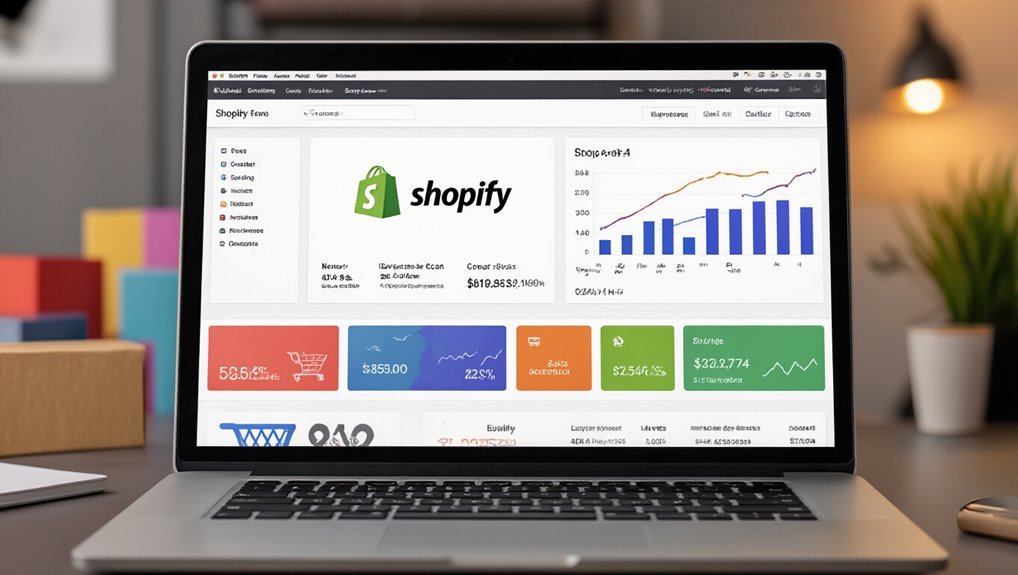
You’ll gain access to Shopify’s thorough feature set during your trial, enabling you to build and test a fully functional online store.
The platform provides 100+ professional store design templates, seamless payment gateway integration with multiple processors, and extensive inventory management tools that track stock levels in real-time.
These core features let you evaluate Shopify’s capabilities against your specific business requirements before committing to a paid plan.
Store Design Templates
Since your store’s visual appeal directly impacts conversion rates, Shopify’s trial version provides access to over 100 professionally designed themes that’ll transform your basic product listings into compelling shopping experiences.
These templates enable thorough store branding through template customization options that align with your business identity. You’ll configure layouts, adjust color schemes, and modify typography without coding knowledge.
- Mobile-responsive designs automatically optimize your store across all devices, ensuring seamless customer experiences.
- Industry-specific templates cater to fashion, electronics, beauty, and home goods with specialized layouts.
- Built-in conversion optimization features include strategic placement of call-to-action buttons and product galleries.
- One-click preview functionality lets you test different themes instantly before committing to design changes.
This design flexibility during your trial period helps establish professional credibility while maximizing sales potential.
Payment Gateway Integration
Beyond creating an attractive storefront, your trial account opens Shopify’s extensive payment processing system that accepts multiple payment methods without requiring separate merchant account applications.

You’ll access Shopify Payments as the primary gateway, which processes credit cards, digital wallets, and buy-now-pay-later options with competitive 2.9% + 30¢ transaction rates.
Your trial includes 100+ gateway options, including PayPal, Stripe, Square, and regional processors. You can configure multiple gateways simultaneously, enabling customers to choose their preferred payment method.
The system automatically calculates fees, processes refunds, and handles fraud protection through machine learning algorithms that analyze transaction patterns.
During your trial period, you’ll test checkout flows, configure tax settings, and evaluate which payment processing combinations optimize conversion rates for your target market.
Inventory Management Tools
While payment processing handles the transaction side of your business, Shopify’s inventory management system transforms your trial store into a sophisticated tracking operation that monitors stock levels, automates reorder points, and prevents overselling across multiple sales channels.
You’ll access powerful tools that eliminate guesswork from stock management. The system tracks inventory across locations, synchronizes counts in real-time, and generates detailed reports on product performance.
- Automated stock alerts notify you when products reach predetermined thresholds, preventing stockouts.
- Multi-location tracking manages inventory across warehouses, stores, and fulfillment centers simultaneously.
- Inventory forecasting analyzes sales patterns to predict future demand and enhance purchasing decisions.
- SKU management organizes variants by size, color, and attributes with barcode scanning capabilities.
These features guarantee you’ll maintain ideal stock levels while maximizing profitability during your trial period.
Building Your First Online Store
You’ll start building your online store by selecting a theme that aligns with your brand strategy and target audience preferences.
Next, you’ll add your product catalog with optimized descriptions, high-quality images, and competitive pricing data.
These foundational steps directly impact your conversion rates and customer engagement metrics during the trial period.
Choose Store Theme
After completing your store setup, selecting the right theme becomes your most critical design decision that directly impacts conversion rates and user experience.
Your theme selection determines how customers navigate your store and perceive your brand’s credibility.
Shopify’s theme store offers both free and premium options optimized for different industries and conversion goals.
Focus on themes with clean layouts, mobile responsiveness, and fast loading speeds—factors that directly influence search rankings and sales performance.
Key theme selection criteria include:
- Mobile optimization – Over 70% of e-commerce traffic comes from mobile devices
- Page loading speed – Every second delay reduces conversions by 7%
- Built-in SEO features – Schema markup and clean code structure boost search visibility
- Customization flexibility – Advanced design customization options without coding requirements
Choose themes that align with your product categories and target audience expectations.
Add Product Catalog
Building your product catalog transforms your empty Shopify store into a functioning business that drives revenue and customer engagement.
Start by uploading high-quality product images and writing compelling descriptions that highlight key benefits. Use bulk uploads through CSV files to efficiently add multiple products simultaneously, saving hours of manual entry.
Implement strategic product categorization to improve customer navigation and search functionality. Create logical categories that match your customers’ shopping behavior rather than your internal organization.
Add essential product details, including pricing, inventory levels, SKUs, and shipping weights.
Configure product variants for items with different sizes, colors, or specifications. Set up SEO-friendly URLs and meta descriptions to improve search visibility.
Your product catalog becomes your primary sales driver, so invest time in optimization.
Adding and Managing Products
Transform your Shopify store from an empty shell into a revenue-generating machine by mastering product management fundamentals. Strategic product organization directly impacts conversion rates and customer experience.
Begin by focusing on your core offerings, providing detailed descriptions that address customer pain points. Upload high-quality images from multiple angles to reduce return rates and build trust. Configure product variations like size, color, or material to maximize inventory potential without creating separate listings.
- Optimize product titles with relevant keywords to improve search visibility and organic traffic.
- Set competitive pricing strategies using market research data to position products effectively.
- Implement inventory tracking to prevent overselling and maintain accurate stock levels.
- Create compelling product descriptions that highlight benefits over features to drive conversions.
For larger catalogs, utilize bulk uploading through CSV files to save time and maintain consistency.
Monitor product performance metrics regularly, adjusting strategies based on sales data and customer feedback to optimize your store’s profitability.
Customizing Your Store Design
Your product catalog forms the foundation, but your store’s visual design determines whether visitors become customers. During your free trial, you’ll access Shopify’s theme library containing professionally designed templates that impact conversion rates by up to 35%.
Choose themes aligned with your brand identity and target demographic. Luxury brands require clean, minimalist store aesthetics, while youth-focused retailers benefit from bold, dynamic design elements. You can customize colors, fonts, layouts, and images without coding knowledge through Shopify’s drag-and-drop editor.
Focus on mobile responsiveness—mobile commerce represents 54% of total e-commerce sales. Test your design across devices to guarantee a consistent user experience. Optimize loading speeds by compressing images and selecting lightweight themes.
Analyze competitor stores within your niche to identify effective design patterns. A/B test different layouts, button colors, and product presentation styles. Track metrics like bounce rate, time on page, and conversion rates to validate design decisions.
Testing Payment and Shipping Options
After customizing your store’s visual appeal, you’ll need to configure the operational backbone that processes customer transactions and deliveries.
Setting up your payment gateway correctly guarantees you can accept credit cards, digital wallets, and other payment methods with minimal transaction failures.
Configuring accurate shipping rates prevents cart abandonment and establishes clear delivery expectations that directly impact your conversion rates and customer satisfaction metrics.
Payment Gateway Setup
Before launching your store to real customers, you’ll need to configure and thoroughly test your payment gateway to guarantee seamless transactions. During your free trial, you can activate Shopify Payments or integrate third-party processors to establish your preferred payment methods.
This testing phase allows you to evaluate transaction fees and identify the most cost-effective solutions for your business model.
- Compare transaction fees across different payment processors to minimize costs and maximize profit margins.
- Test multiple payment methods, including credit cards, PayPal, and digital wallets, to accommodate customer preferences.
- Verify international payment processing if you plan to sell globally during your trial period.
- Configure automated tax calculations and ascertain that they integrate properly with your chosen payment gateway.
Shipping Rate Configuration
Once you’ve established your payment processing system, configuring accurate shipping rates becomes critical for maintaining profit margins and meeting customer expectations. You’ll need to define shipping zones based on geographic regions where you deliver products. Each zone requires specific rate calculations that reflect actual costs from your chosen shipping carriers.
| Shipping Zone | Rate Type | Carrier Options |
|---|---|---|
| Domestic | Flat/Calculated | USPS, UPS, FedEx |
| International | Weight-based | DHL, FedEx International |
| Local | Distance-based | Local courier services |
| Express | Premium rates | All major carriers |
Start by researching your shipping carriers’ actual rates, then add your desired markup percentage. Test different scenarios using various product weights and destinations. This data-driven approach guarantees you’re covering costs while remaining competitive. Configure backup carriers for reliability during peak seasons or service disruptions.
Exploring Marketing and SEO Tools
While building your online store represents just the beginning of your e-commerce journey, Shopify’s integrated marketing and SEO tools transform your free trial into a strategic testing ground for customer acquisition tactics.
You’ll access extensive SEO strategies through built-in optimization features that analyze your product descriptions, meta tags, and site structure. The platform’s marketing analytics dashboard provides real-time performance metrics, enabling data-driven decisions about campaign effectiveness and customer behavior patterns.
Key marketing and SEO capabilities include:
- Email marketing automation with customizable templates and segmentation tools for targeted campaigns
- Social media integration connecting Facebook, Instagram, and Google channels for streamlined advertising
- SEO optimization suite featuring keyword analysis, sitemap generation, and mobile-friendly testing
- Analytics tracking, monitoring conversion rates, traffic sources, and customer acquisition costs
These tools eliminate guesswork from your marketing efforts, providing measurable insights that guide strategic adjustments during your trial period and beyond.
Understanding Pricing Plans After Trial
As your free trial nears its end, you’ll need to evaluate Shopify’s pricing structure to determine which plan aligns with your business requirements and projected growth trajectory.
Trial pricing shifts into three distinct subscription tiers, each designed for different business scales. Plan comparisons reveal significant feature variations that directly impact operational capabilities.
| Plan | Monthly Cost | Transaction Fees |
|---|---|---|
| Basic | $39 | 2.9% + 30¢ |
| Shopify | $105 | 2.6% + 30¢ |
| Advanced | $399 | 2.4% + 30¢ |
Basic Shopify suits startups with essential e-commerce functionality. The standard Shopify plan offers professional reporting and gift cards, ideal for growing businesses. Advanced Shopify provides third-party calculated shipping rates and advanced report building for established enterprises.
Calculate your projected monthly transaction volume against each plan’s fees. Higher-tier plans reduce per-transaction costs but increase fixed monthly expenses. Choose based on your sales volume projections rather than current trial metrics.
Making the Most of Your Trial Experience
Beyond selecting the right pricing plan, you’ll maximize your trial’s value by systematically testing Shopify’s core features that directly impact your revenue potential.
Effective trial strategies focus on features that’ll generate immediate insights about your business viability. You’ll want to test customer acquisition channels, conversion optimization tools, and payment processing efficiency during these vital weeks.
Key areas to prioritize for maximizing engagement:
- Product catalog setup – Upload your inventory and test product page layouts to identify the highest-converting designs
- Payment gateway integration – Process test transactions to guarantee smooth checkout experiences across different payment methods
- Marketing tool evaluation – Experiment with email campaigns, discount codes, and social media integrations to measure response rates
- Analytics dashboard analysis – Monitor visitor behavior, conversion funnels, and sales data to understand customer patterns
Document performance metrics throughout your trial period. This data-driven approach guarantees you’ll make informed decisions about Shopify’s long-term fit for your business goals.
Frequently Asked Questions
Can I Use My Own Domain Name During the Free Trial?
You can’t use your own custom domain setup during Shopify’s free trial due to trial domain limitations.
You’ll receive a temporary myshopify.com subdomain instead. This restriction guarantees you experience the platform’s core functionality while limiting full customization features.
Once you upgrade to a paid plan, you’ll access custom domain capabilities.
Focus on testing product management, checkout processes, and design features during your trial to maximize evaluation effectiveness.
Will My Trial Data Be Deleted if I Don’t Upgrade?
Your trial data won’t be permanently deleted immediately after expiration.
Shopify typically retains trial account features and data for a limited period, allowing you to upgrade and recover everything.
However, extended delays risk permanent data loss. You’ll lose access to your store and customer information if you don’t upgrade within their retention window.
Upgrade promptly to guarantee trial data retention and maintain business continuity.
Can I Switch Between Different Trial Plans Before Subscribing?
You can’t switch between different trial plan options during your 14-day free trial period.
Shopify’s trial gives you access to all features across plans, so switching trials isn’t necessary or possible. You’ll evaluate all functionalities within this single trial experience.
When your trial ends, you’ll choose your subscription plan based on the data you’ve gathered about which features best support your business requirements and growth objectives.
Is There a Limit on Customer Accounts During the Trial?
Customer account limitations do not restrict you during your trial period.
Shopify’s trial account features include unlimited customer accounts, allowing you to test your store’s capacity without constraints.
This gives you accurate data on how your business will scale. You can add as many customers as needed to evaluate performance metrics and conversion rates, ensuring you’re making an informed subscription decision based on real usage patterns.
Can I Export My Store Data Before the Trial Expires?
Yes, you can perform a data export before your trial expires.
Access your admin dashboard and navigate to Settings > Data export to create a thorough store backup.
Export customer data, product catalogs, order history, and inventory records in CSV format.
This strategic move guarantees you’ll retain all critical business data regardless of whether you continue with Shopify or migrate elsewhere.
Conclusion
You’ve got 14 days to validate your business model and test core functionalities. Focus your trial on high-impact activities: upload your best-selling products, configure payment processors, and run traffic to measure conversion rates. Track key metrics like cart abandonment and checkout completion. Don’t waste time on design perfection—prioritize revenue-generating features. Analyze your trial data to determine which Shopify plan delivers the best ROI for your projected sales volume and required features.
Table of Contents
- 1 Key Takeaways
- 2 What You Get During Your Trial Period
- 3 Setting Up Your Free Shopify Account
- 4 Key Features Available in the Trial Version
- 5 Building Your First Online Store
- 6 Adding and Managing Products
- 7 Customizing Your Store Design
- 8 Testing Payment and Shipping Options
- 9 Exploring Marketing and SEO Tools
- 10 Understanding Pricing Plans After Trial
- 11 Making the Most of Your Trial Experience
- 12 Frequently Asked Questions
- 13 Conclusion









No Comments