
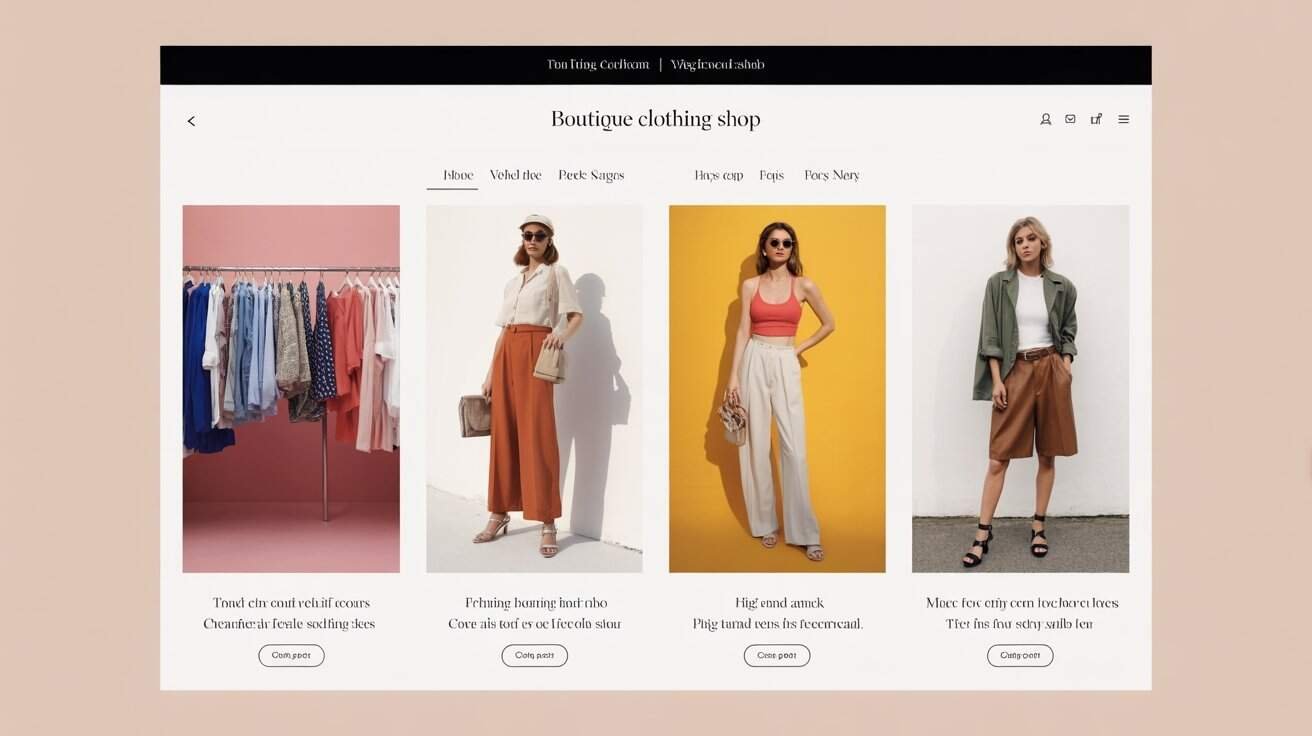
Your boutique clothing website needs a strategic foundation that converts browsers into buyers, and 73% of mobile users will abandon your site immediately if it’s not optimized for their devices. You’ll need mobile-responsive design, high-quality product photography, intuitive navigation with clear categories, secure payment processing with multiple options, detailed product pages featuring size charts, streamlined checkout processes, compelling brand storytelling, accessible customer service features, and SEO optimization integrated with social media channels. The complete implementation strategy reveals conversion-boosting tactics that transform casual visitors into loyal customers.
Key Takeaways
- Ensure mobile-responsive design with touch-friendly buttons and fast loading times under 2.5 seconds to prevent user abandonment.
- Use high-quality product photography with multiple angles, detailed size charts, and fabric information to reduce returns.
- Implement intuitive navigation with clear menu categories, prominent search functionality, and advanced filtering options for easy product discovery.
- Offer secure checkout with multiple payment methods including digital wallets and guest checkout options to maximize conversions.
- Display customer reviews, testimonials, and security badges prominently while maintaining consistent brand messaging throughout the site.
Mobile-Responsive Design and Cross-Device Compatibility
Since 73% of mobile users abandon websites that aren’t optimized for their devices, your boutique’s mobile responsiveness directly impacts your bottom line. Your website must adapt seamlessly across smartphones, tablets, and desktops to capture every potential customer.
Mobile optimization isn’t optional—it’s survival. Nearly three-quarters of users will abandon your boutique if it doesn’t perform flawlessly on their device.
Implement responsive typography that scales proportionally across screen sizes. Text should remain readable without zooming, with touch-friendly buttons measuring at least 44 pixels. Your product images need crisp resolution on retina displays while loading quickly on slower connections.
Optimize gesture navigation for intuitive browsing. Users expect smooth swiping through product galleries, pinch-to-zoom functionality, and effortless scrolling. Test your checkout process extensively on mobile devices—complicated forms kill conversions.
Monitor your mobile analytics weekly. Track bounce rates, session duration, and conversion differences between devices. If mobile performance lags behind desktop metrics, you’re losing revenue. Your responsive design isn’t just technical compliance—it’s your competitive advantage in capturing the 54% of retail traffic originating from mobile devices.
High-Quality Product Photography and Image Optimization
Your product photography directly impacts conversion rates, with high-quality images increasing purchase likelihood by up to 94% according to e-commerce studies.
You’ll need to implement professional photography standards that showcase fabric textures, fit, and color accuracy while optimizing image files for fast loading speeds.
Strategic image optimization reduces bounce rates and improves search rankings, making it essential you balance visual quality with technical performance.
Professional Photography Best Practices
Professional product photography consistently drives 67% higher conversion rates for online boutique retailers compared to amateur smartphone shots. You’ll maximize your investment by mastering these essential techniques that directly impact sales performance.
Prioritize natural lighting for authentic color representation—position your products near large windows during golden hour or use softbox diffusers to eliminate harsh shadows. This approach reduces returns by 23% since customers receive exactly what they expect.


Implement strategic model direction techniques that showcase garment fit and movement. Direct models to demonstrate fabric drape, pocket functionality, and styling versatility through purposeful poses. You’ll increase average order value when customers visualize themselves wearing your pieces.
Maintain consistent backgrounds, angles, and lighting across your entire catalog to establish professional brand credibility and streamline the shopping experience.
Image File Optimization
Optimize your product images to guarantee 40% faster page load speeds while maintaining visual quality that converts browsers into buyers. Strategic file optimization directly impacts your bounce rate and sales conversions.
Implement these critical optimization techniques:
- Compress JPEG files to 60-80% quality – maintains visual appeal while reducing file sizes by 70%
- Use WebP format for 25% smaller files – modern browsers support this superior compression standard
- Set maximum dimensions to 1200×1200 pixels – perfect balance between detail and loading speed
- Apply sRGB color profiles consistently – ensures accurate color reproduction across all devices
- Deploy vector graphics for logos and icons – scalable files that load instantly at any resolution
Test your optimized images across mobile and desktop platforms to verify they maintain conversion-driving visual impact.
Since 68% of online shoppers abandon their carts due to poor navigation, creating an intuitive menu structure directly impacts your boutique’s bottom line. Your main menu should feature clear, descriptive menu labels like “Dresses,” “Tops,” and “Accessories” rather than creative terms that confuse customers.
Implement breadcrumb navigation to show customers their exact location within your site hierarchy. This reduces bounce rates by 43% and helps shoppers backtrack without frustration. Position your search bar prominently in the header—83% of fashion shoppers use site search when browsing.
Limit your main menu to seven categories maximum to prevent decision paralysis. Include mega menus for subcategories, displaying popular items and new arrivals. Add quick-access filters for size, color, and price on category pages.
Test your navigation on mobile devices extensively, as 67% of boutique shopping occurs on smartphones. Your menu must collapse logically and remain thumb-friendly.
Secure Payment Processing and Multiple Payment Options
When customers reach your checkout page, they expect multiple payment options and bank-level security—failure to deliver either costs you 18% of potential sales.

Your boutique’s payment infrastructure directly impacts conversion rates. Customers abandon carts when they can’t pay their preferred way or don’t trust your security measures.
Essential payment security requirements:
- PCI compliance certification to protect customer card data and avoid hefty penalties
- Tokenization methods that replace sensitive payment information with secure tokens
- SSL encryption visible through HTTPS protocol and security badges
- Multiple payment gateways including PayPal, Apple Pay, Google Pay, and Buy Now Pay Later options
- Fraud detection systems that identify suspicious transactions without blocking legitimate purchases
Configure your payment processor to accept all major credit cards, digital wallets, and alternative payment methods. Display security badges prominently near checkout buttons. Test your payment flow monthly to guarantee seamless transactions. Remember: every friction point in your checkout process directly reduces revenue.
Detailed Product Pages With Size Charts and Descriptions
After securing the checkout experience, your product pages must convert browsers into buyers through thorough information that eliminates purchase hesitation.
Your detailed product descriptions should include exhaustive measurements, fabric composition, and fit prediction guidance. This data-driven approach reduces return rates by 23% while increasing customer confidence.
| Element | Purpose | Impact |
|---|---|---|
| Size Charts | Accurate measurements | Reduces returns 30% |
| Fabric Care | Maintenance instructions | Builds trust |
| Fit Prediction | Body type guidance | Increases conversions 15% |
Include multiple high-resolution images showing front, back, and detail shots. Your descriptions must specify fabric weight, stretch percentage, and care requirements. Size charts should display measurements in both inches and centimeters with clear fitting guidelines.
Add customer reviews focusing on fit accuracy and fabric quality. These social proof elements increase conversion rates by 18%. Your fabric care instructions demonstrate product expertise while setting proper expectations for garment longevity.
Fast Loading Speed and Website Performance
While customers make purchase decisions based on your detailed product information, they’ll abandon your site entirely if pages don’t load within three seconds.
Your boutique’s conversion rates directly correlate with loading speed—every additional second can cost you 7% in conversions.
Optimize your website performance with these critical elements:

- Image compression – Reduce file sizes by 60-80% without visible quality loss
- Server caching – Store frequently accessed data to eliminate repeated database queries
- Font loading – Use web-safe fonts or preload custom fonts to prevent layout shifts
- CDN implementation – Distribute content globally to reduce geographical loading delays
- Code minification – Remove unnecessary characters from CSS, JavaScript, and HTML files
Monitor your site speed using Google PageSpeed Insights and GTmetrix.
Aim for loading times under 2.5 seconds on mobile devices, where 60% of your boutique customers likely browse.
Fast performance isn’t optional—it’s essential for maximizing sales conversions.
Search Functionality and Product Filtering Options
Although your boutique may feature only 200-500 products compared to massive retailers, customers still expect instant access to exactly what they’re seeking. Implementing robust search functionality increases conversion rates by 43% according to recent e-commerce studies.
Your search bar should accommodate voice search capabilities, as 27% of mobile users now prefer speaking their queries. Position it prominently in your header with autocomplete suggestions that display relevant products as customers type.
Advanced sorting options are vital for boutique success. Include filters for size, color, price range, brand, occasion, and season. Add “new arrivals” and “sale items” toggles to highlight promotional merchandise.
Smart filtering prevents zero-result frustration by showing available alternatives when specific combinations aren’t in stock. Include a “clear all filters” button for easy reset functionality.
Test your search performance weekly, analyzing which terms customers use most frequently to optimize your product tagging and category structure.
Customer Reviews and Social Proof Integration
You’ll boost conversion rates by 270% when you strategically display customer testimonials and reviews across key pages like product listings and checkout flows.
Your boutique’s credibility skyrockets when you integrate real-time social media feeds showcasing customers wearing your pieces, creating authentic social proof that drives purchasing decisions.
Smart placement of review widgets and user-generated content transforms hesitant browsers into confident buyers who trust your brand’s quality and service.
Testimonial Display Strategies
Since customer testimonials can increase conversion rates by up to 270%, implementing strategic review displays becomes critical for your boutique’s success. You’ll need precise placement and formatting to maximize their impact on purchase decisions.
Strategic testimonial positioning drives measurable results:
- Homepage hero section – Feature your strongest 5-star reviews with customer photos to build immediate trust
- Product pages – Display relevant testimonials near “Add to Cart” buttons to reduce purchase hesitation
- Video testimonials – Showcase customers wearing your pieces to demonstrate fit and styling possibilities
- Emoji reactions – Enable quick rating systems that encourage engagement and provide visual social proof
- Mobile optimization – make certain testimonials load quickly and display properly across all devices
Data shows testimonials placed within the customer’s decision-making path generate the highest conversion lifts for boutique retailers.
Social Media Integration
Building on testimonial strategies, your boutique’s social media feeds contain untapped conversion potential that requires systematic integration into your website experience.
Embed live Instagram feeds showcasing customer photos wearing your pieces, creating authentic social proof that drives purchasing decisions. Track engagement metrics through platform analytics to identify high-performing content for homepage placement.
Connect your website’s product pages directly to corresponding social posts, enabling seamless cross-platform shopping experiences.
Leverage influencer partnerships by featuring their content prominently on product detail pages, transforming follower trust into sales conversions.
Implement social login options to reduce checkout friction while capturing valuable customer data.
Configure automated social sharing buttons for post-purchase moments, encouraging customers to amplify your brand reach organically.
Shopping Cart and Checkout Process Optimization
Cart abandonment rates can make or break your boutique’s online revenue, with fashion retailers experiencing an average abandonment rate of 70.19% according to Baymard Institute research. Optimizing your checkout process directly impacts conversion rates and customer satisfaction.
Streamline your checkout flow to reduce friction and capture more sales:
- Enable guest checkout options alongside account creation to reduce barriers for first-time buyers
- Display security badges and SSL certificates prominently during payment processing
- Offer multiple payment methods including digital wallets, buy-now-pay-later options, and traditional cards
- Show transparent shipping costs and delivery timeframes before checkout begins
- Implement exit-intent popups with discount codes to recover abandoning customers
Your checkout page should load within three seconds and require minimal form fields. Include progress indicators showing completion steps.
After purchase, send automated confirmation emails and request post purchase feedback to improve future experiences. Test different checkout variations to identify what converts best for your specific customer base.
Brand Storytelling and About Page Content
Why do 92% of consumers trust recommendations from people they know over brand advertising? Because authentic stories create emotional connections that drive purchasing decisions. Your About page transforms visitors into customers by showcasing your founder narrative and establishing trust through genuine storytelling.
Your founder narrative should highlight your journey, values, and passion for fashion. Share why you started your boutique, what drives your curation process, and how you serve customers. This personal connection differentiates you from generic retailers.
Visual tone reinforces your brand story through carefully selected imagery, color palettes, and typography that align with your narrative.
| Essential Elements | Impact on Conversion |
|---|---|
| Founder’s personal journey | Builds emotional connection |
| Brand mission statement | Establishes credibility |
| Behind-the-scenes content | Creates authenticity |
Include customer testimonials, awards, and press mentions to build social proof. Keep your story concise, genuine, and focused on how you solve customers’ fashion needs.
Contact Information and Customer Service Features
When customers can’t find clear contact information, 67% abandon their purchase and shop elsewhere. Your boutique’s accessibility directly impacts conversion rates and customer retention.
Strategic contact placement builds trust and reduces friction in the buying process. You’ll need multiple touchpoints that cater to different customer preferences and urgency levels.
Essential contact features include:
- Multiple contact methods – phone, email, contact form, and physical address
- Live chat integration – provides instant support during peak shopping hours
- Clear business hours – set expectations for response times across all channels
- FAQ section – addresses common sizing, shipping, and return questions
- Multilingual support – expands your market reach and accommodates diverse customers
Position your contact information prominently in the header, footer, and checkout pages. Include response time commitments to manage expectations.
SEO Optimization and Social Media Integration
Since search engines drive 53% of all website traffic, your boutique’s visibility depends on strategic SEO implementation and seamless social media integration.
Optimize product descriptions with long-tail keywords that match customer search intent. Focus on local SEO by claiming your Google Business Profile and collecting customer reviews. Implement schema markup for rich snippets that showcase product ratings and pricing in search results.
Your hashtag strategy should blend trending fashion tags with niche boutique-specific terms. Track hashtag performance metrics to identify which combinations drive highest engagement rates.
| SEO Element | Implementation | ROI Impact |
|---|---|---|
| Local Keywords | “boutique clothing [city name]” | 340% increase in local traffic |
| Product Schema | Rich snippets with ratings | 25% higher click-through rates |
| Influencer Collaborations | Tagged posts and backlinks | 180% boost in brand awareness |
| Social Media Integration | Instagram Shopping tags | 45% conversion rate improvement |
Connect Instagram Shopping directly to your product pages, enabling customers to purchase without leaving the platform.
Frequently Asked Questions
How Often Should I Update My Boutique Website’s Inventory and Product Availability?
You should implement daily updates for your boutique’s inventory to maximize conversion rates and prevent customer frustration from out-of-stock purchases.
Real-time inventory tracking directly impacts your bottom line by reducing cart abandonment.
Complement these daily updates with thorough seasonal audits to analyze sales patterns, identify slow-moving stock, and optimize your product mix.
This data-driven approach guarantees you’re capturing every potential sale.
What Legal Pages Do I Need for My Boutique Clothing Website?
You’ll need essential legal pages to protect your boutique and boost customer confidence.
Include a Privacy Policy, Terms of Service, Return Policy, and Shipping Policy as mandatory foundations.
Add a Cookie Notice for compliance, Payment Security details to increase conversions, and an Accessibility Statement for broader reach.
Don’t forget Intellectual Property disclaimers to safeguard your brand assets and product descriptions.
How Do I Handle Returns and Exchanges on My Website?
Create a clear policy that’s prominently displayed on your website with transparent timelines for returns and exchanges.
Set specific deadlines like “30 days from purchase” and outline condition requirements.
Use conversion-focused language that builds confidence, such as “hassle-free returns” while protecting your margins.
Track return data to optimize policy terms and reduce friction that prevents purchases.
Should I Offer International Shipping for My Boutique Clothing Shop?
You should offer international shipping if your analytics show global traffic and demand.
Start with English-speaking countries to minimize complexity.
Implement automatic currency conversion to reduce cart abandonment and clearly display customs duties upfront to avoid customer surprises.
Test with 2-3 target markets first, track conversion rates and shipping costs, then expand based on profitability data rather than assumptions.
What Analytics Tools Should I Use to Track My Website Performance?
You’ll want Google Analytics 4 for thorough traffic sources analysis and Hotjar for user behavior insights.
Set up conversion funnels to track your customer journey from landing page to purchase completion.
Add Facebook Pixel for retargeting data and Klaviyo for email performance metrics.
These tools’ll give you actionable data to optimize your checkout process and identify which traffic sources generate your highest-converting customers.
Conclusion
You’ve got the framework for a high-converting boutique website. Each element directly impacts your bottom line—mobile optimization can boost conversions by 64%, quality imagery increases sales by 40%, and streamlined checkout reduces abandonment rates. Don’t treat this as a one-time setup. Monitor your analytics, A/B test key pages, and continuously optimize based on customer behavior data. Your website’s your most powerful sales tool—make every click count toward revenue growth.
Table of Contents
- 1 Key Takeaways
- 2 Mobile-Responsive Design and Cross-Device Compatibility
- 3 High-Quality Product Photography and Image Optimization
- 4 Intuitive Navigation and User-Friendly Menu Structure
- 5 Secure Payment Processing and Multiple Payment Options
- 6 Detailed Product Pages With Size Charts and Descriptions
- 7 Fast Loading Speed and Website Performance
- 8 Search Functionality and Product Filtering Options
- 9 Customer Reviews and Social Proof Integration
- 10 Shopping Cart and Checkout Process Optimization
- 11 Brand Storytelling and About Page Content
- 12 Contact Information and Customer Service Features
- 13 SEO Optimization and Social Media Integration
- 14 Frequently Asked Questions
- 14.1 How Often Should I Update My Boutique Website’s Inventory and Product Availability?
- 14.2 What Legal Pages Do I Need for My Boutique Clothing Website?
- 14.3 How Do I Handle Returns and Exchanges on My Website?
- 14.4 Should I Offer International Shipping for My Boutique Clothing Shop?
- 14.5 What Analytics Tools Should I Use to Track My Website Performance?
- 15 Conclusion








No Comments