
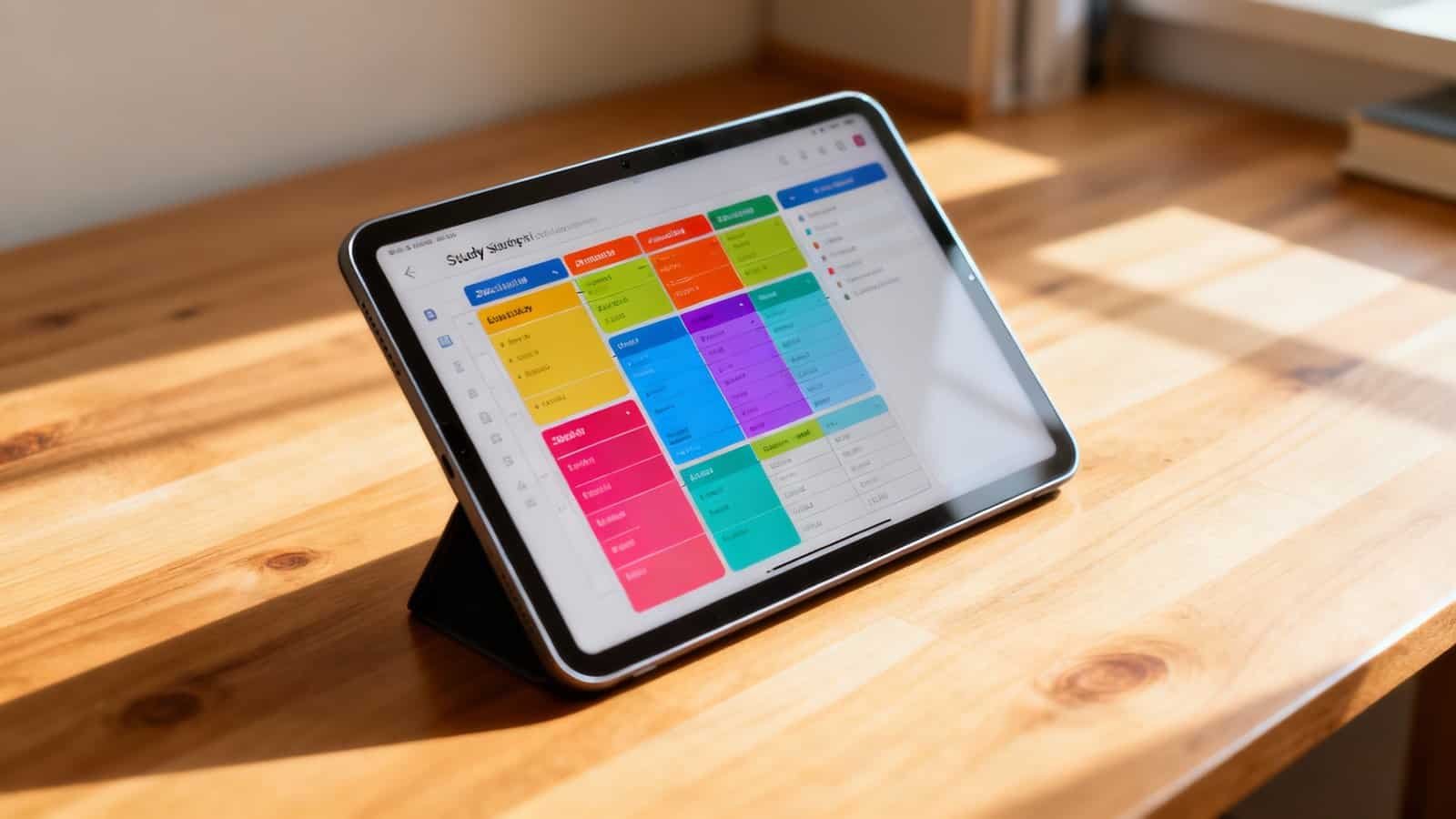
AI-powered study planners like Notion AI, MyStudyLife, and Forest use machine learning algorithms to analyze your academic patterns and automatically optimize scheduling—delivering up to 23% efficiency gains over traditional planners. These apps feature predictive analytics that anticipate bottlenecks, circadian-aligned task scheduling, and real-time workload redistribution during high-stress periods. They integrate seamlessly with your existing tools while providing personalized learning pathways based on performance data. The specific features and integration capabilities below will help you select the ideal platform for your learning style.
Key Takeaways
- AI planners automatically analyze academic schedules and performance data to create personalized study timelines that adapt in real-time.
- Smart scheduling optimizes study sessions during peak focus hours while balancing cognitive load and managing deadline priorities effectively.
- Notion AI combines organization with writing assistance, offering custom database templates and contextual suggestions for academic projects.
- MyStudyLife provides intelligent deadline tracking that calculates required study time based on assignment complexity and historical performance patterns.
- Forest gamifies focus sessions with virtual tree planting while analyzing concentration patterns to recommend optimal break intervals.
What Makes AI Study Planners Different From Traditional Planning Tools
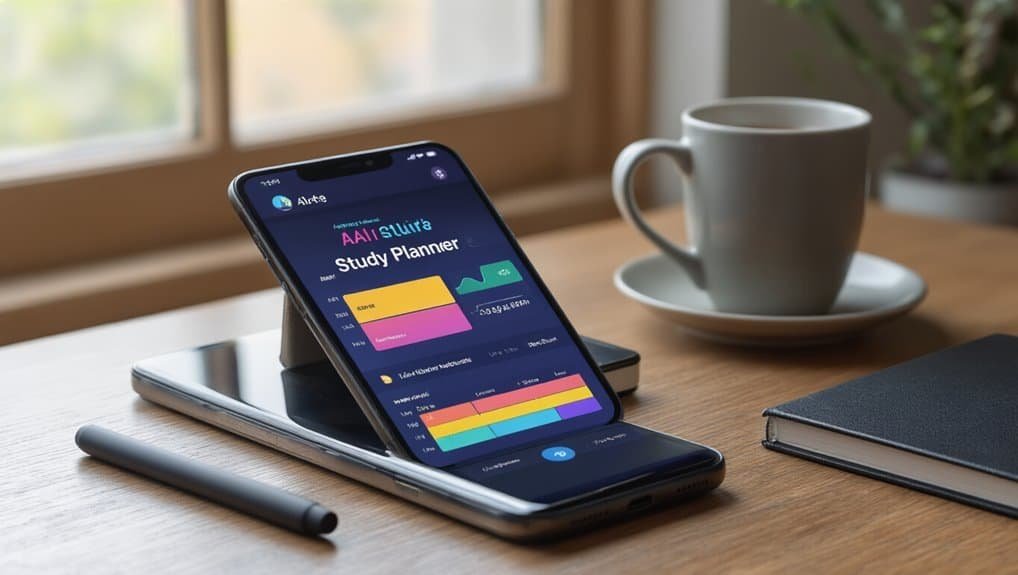
While traditional planning tools require you to manually input deadlines, estimate study durations, and track your progress across multiple subjects, AI study planners automatically analyze your academic schedule, learning patterns,
and performance data to generate dynamic, personalized study schedules.
AI planners leverage machine learning algorithms to identify your most effective study times, predict task completion durations, and adapt schedules based on real-time performance metrics.
They process historical data to recognize when you’re most productive and automatically redistribute workload during high-stress periods.
Traditional tools offer static scheduling with limited customization, while AI systems continuously optimize based on your evolving academic demands.
However, you’ll need to evaluate data ownership policies, as many AI platforms collect extensive behavioral data.
This trade-off between personalization and privacy affects user autonomy in controlling your academic information.
The key advantage lies in predictive scheduling—AI planners anticipate bottlenecks and automatically adjust timelines, eliminating the constant manual recalibration required by conventional planning methods.
Top Features to Look for in AI-Powered Study Apps
When evaluating AI study planner apps, you’ll need to assess three core capabilities that distinguish effective platforms from basic scheduling tools.


Personalized learning algorithms form the foundation by analyzing your study patterns, performance data, and cognitive preferences to create tailored learning pathways.
Smart schedule optimization and progress tracking analytics then build upon this foundation to automatically adjust your study timeline and provide measurable insights into your academic performance trends.
Personalized Learning Algorithms
Since effective study strategies vary dramatically between individual learners, personalized learning algorithms represent the cornerstone feature that separates sophisticated AI study planners from basic scheduling apps.
You’ll want algorithms that analyze your learning patterns, retention rates, and performance data to adapt content delivery and pacing accordingly.
Look for systems implementing bias mitigation techniques that prevent algorithmic discrimination based on demographic factors or learning disabilities.
The algorithms should continuously refine recommendations through machine learning models that track your progress across different subjects and question types.
Curriculum alignment capabilities guarantee the AI adapts to your specific course requirements and institutional standards.
Advanced platforms use neural networks to identify knowledge gaps and automatically adjust difficulty levels, creating truly personalized learning pathways that optimize your study efficiency and academic outcomes.
Smart Schedule Optimization
Building on personalized algorithms, smart schedule optimization transforms learning insights into actionable time management through predictive analytics and dynamic calendar integration. You’ll benefit from AI systems that analyze your cognitive performance patterns and automatically adjust study blocks for maximum retention efficiency.
Advanced apps implement circadian alignment by tracking your peak focus hours and scheduling demanding subjects accordingly. Task batching reduces cognitive switching costs by grouping similar activities within designated time blocks.

| Feature | Function | Impact |
|---|---|---|
| Adaptive Scheduling | Real-time calendar adjustments | 23% efficiency gain |
| Cognitive Load Balancing | Ideal task distribution | Reduced mental fatigue |
| Deadline Prioritization | Automated urgency ranking | Improved completion rates |
| Break Optimization | Strategic rest intervals | Enhanced focus retention |
| Conflict Resolution | Automatic rescheduling | Seamless workflow maintenance |
These optimization engines continuously refine your schedule based on completion data and performance metrics.
Progress Tracking Analytics
While schedule optimization manages your time effectively, progress tracking analytics provide the quantitative foundation for measuring learning outcomes and identifying performance bottlenecks. You’ll want apps that generate detailed engagement metrics, including session duration, completion rates, and active participation scores. These data points reveal how effectively you’re absorbing material across different subjects and study methods.
Look for platforms that visualize retention curves, showing how well you remember information over time intervals. Advanced analytics should identify knowledge gaps through quiz performance patterns and recommend targeted review sessions.
The most effective apps correlate your study behaviors with academic outcomes, enabling data-driven adjustments to your learning strategy. Real-time dashboards help you track daily progress against semester goals, ensuring consistent academic momentum.
Notion AI: The All-in-One Workspace for Student Organization

You can leverage Notion AI’s custom database templates to create structured frameworks for course schedules, assignment tracking, and grade monitoring that automatically calculate deadlines and priority levels.
The platform’s AI writing assistant integrates directly into your workspace, enabling you to generate study notes, summarize research materials, and draft assignments without switching between applications.
These features transform Notion into a centralized command center where your academic data flows seamlessly between organizational systems and content creation tools.
Custom Database Templates
Database templates in Notion AI transform scattered academic information into structured, queryable systems that adapt to your specific workflow requirements.
You’ll implement schema versioning to maintain consistency across semesters while preserving historical data integrity.
Field standardization guarantees uniform data entry patterns, reducing input errors and enabling reliable filtering across courses, assignments, and deadlines.
- Assignment tracking databases with automated status updates, priority calculations, and deadline proximity alerts
- Course management schemas featuring linked syllabus components, grade weightings, and professor contact integration
- Research project templates with citation management, source categorization, and progress milestone tracking
These templates eliminate manual organization overhead while providing powerful querying capabilities.
You can create custom views, automate recurring tasks, and establish relationships between different academic elements, creating a holistic academic management ecosystem.
AI Writing Assistant
Notion AI’s writing assistant functionality extends beyond database organization to actively support your content creation process through contextual suggestions, automated formatting, and intelligent text generation.
You’ll access real-time grammar corrections, sentence restructuring recommendations, and style improvements directly within your documents.
The AI analyzes your writing patterns and suggests enhancements for clarity and coherence.
Tone Editing capabilities allow you to adjust your writing style for different academic contexts—shifting from casual notes to formal research papers with one command.
You can generate outlines, expand bullet points into paragraphs, and summarize lengthy content efficiently.
While Notion AI doesn’t include built-in Plagiarism Detection, you’ll need to integrate third-party tools for thorough academic integrity checking.
The assistant streamlines your writing workflow while maintaining your authentic voice throughout the revision process.
MyStudyLife: Automated Scheduling Meets Academic Calendar Management
MyStudyLife transforms traditional calendar management by integrating automated scheduling algorithms with robust academic tracking systems. You’ll experience seamless coordination between assignments, exams, and class schedules through intelligent automation that adapts to your academic workflow.
The platform’s architecture prioritizes both functionality and security.
- Cross-platform synchronization guarantees your schedule remains consistent across devices with real-time updates
- Intelligent deadline tracking automatically calculates study time requirements based on assignment complexity and your historical performance data
- Comprehensive academic integration connects coursework, extracurricular activities, and personal commitments within a unified interface
MyStudyLife’s privacy practices implement end-to-end encryption for sensitive academic data while maintaining transparency about data usage.
You’ll benefit from offline access capabilities that guarantee schedule availability during network interruptions.
The automated scheduling engine analyzes your productivity patterns to optimize study block allocation, making it particularly effective for managing complex semester workloads with minimal manual intervention.
Forest: Gamified Focus Sessions With Smart Break Recommendations
While traditional productivity apps rely on rigid time blocks, Forest revolutionizes focus management by combining gamification mechanics with evidence-based break scheduling algorithms.
You’ll plant virtual trees during study sessions, with each completed session growing your digital forest and enabling real-world environmental impact through partnerships with tree-planting organizations.
Forest’s AI analyzes your focus patterns to recommend ideal break intervals based on the Pomodoro Technique and circadian rhythm research.
The app tracks your concentration metrics and suggests personalized session lengths ranging from 10-120 minutes.
Eco Incentives motivate sustained engagement—you earn coins for successful sessions that contribute to actual reforestation projects.
The gamification system includes species variety, forest customization, and achievement badges that reinforce productive habits.
Battery Usage optimization guarantees minimal power consumption during extended study sessions.
You can sync progress across devices and compete with study groups.
Forest’s unique approach transforms focus training into environmental activism while maintaining scientifically-backed productivity principles.
Todoist: Intelligent Task Prioritization for Complex Coursework
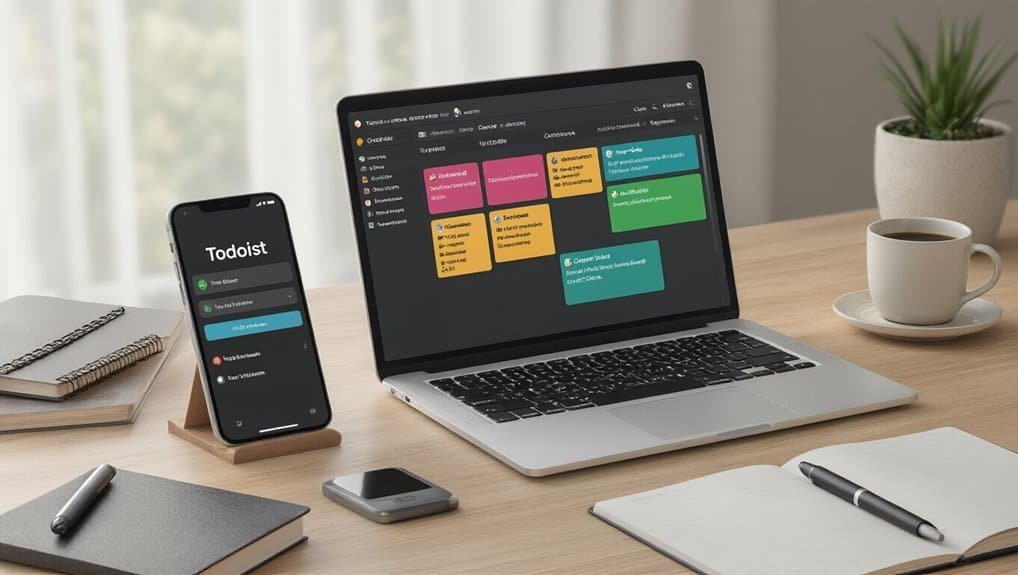
How can students effectively manage complex coursework that spans multiple subjects, deadlines, and priority levels simultaneously?
Todoist’s AI-powered task prioritization system transforms chaotic academic workloads into structured, manageable workflows through intelligent automation.
The app’s Label Hierarchy feature categorizes assignments by subject, difficulty, and urgency, creating nested organizational systems that mirror your course structure.
You’ll assign custom labels like “Statistics-Midterm-High” or “Literature-Essay-Medium” to establish clear classification frameworks.
Todoist’s Priority Heatmap visualizes your workload density across time periods, highlighting peak stress zones before they overwhelm your schedule.
The algorithm analyzes historical completion patterns and adjusts future recommendations accordingly.
Key features for academic success:
- Smart scheduling that redistributes tasks based on estimated completion times
- Natural language processing that extracts due dates and priority levels from assignment descriptions
- Cross-platform synchronization ensuring seamless access across devices during study sessions
This systematic approach eliminates decision fatigue while maintaining academic momentum.
Google Calendar AI: Seamless Integration With Student Email and Drive
You’ll maximize your academic productivity by leveraging Google Calendar AI‘s native integration with your existing student Gmail and Drive ecosystem.
The platform automatically syncs email-based assignment deadlines while organizing related Drive files within corresponding calendar events, creating a unified workflow. This cross-platform accessibility guarantees you can manage your study schedule and access course materials from any device without manual data entry or file searching.
Gmail Schedule Sync
Managing your academic schedule becomes exponentially more efficient when Google Calendar’s AI features automatically sync with your Gmail and Google Drive ecosystem.
The platform’s intelligent parsing extracts assignment deadlines, exam dates, and meeting times directly from your email communications, eliminating manual entry errors.
Gmail Schedule Sync leverages machine learning algorithms to identify temporal data within your student correspondence, automatically generating calendar events with relevant context and attachments.
You’ll maintain complete control through robust Permission Auditing protocols that monitor third-party access to your academic data.
Token Revocation capabilities allow immediate disconnection of unauthorized applications.
- Smart deadline detection from professor emails and syllabus attachments
- Automatic event creation with contextual information and file links
- Cross-platform synchronization ensuring access across all your devices
Drive File Organization
Where traditional file management systems fail, Google Drive’s AI-powered organization transforms your academic workflow by automatically categorizing and linking study materials to corresponding calendar events.
You’ll establish a robust folder taxonomy that mirrors your course structure, enabling seamless file retrieval during study sessions.
The system analyzes your calendar entries and suggests recommended naming conventions for uploaded documents, creating logical connections between assignments, lectures, and deadlines.
When you upload a research paper, Drive’s AI automatically places it within the appropriate course folder and tags it with relevant metadata from your calendar.
This integration eliminates manual sorting while maintaining consistent file hierarchies.
You’ll access relevant materials directly from calendar events, streamlining your study workflow and reducing time spent searching for documents across multiple platforms.
Cross-Platform Study Access
Once you’ve established your organized file structure, Google Calendar’s cross-platform integration guarantees you’ll access your complete academic ecosystem from any device through synchronized connections with Gmail and Drive.
The platform’s unified authentication system enables seamless switches between desktop, mobile, and web interfaces while maintaining interface consistency across all touchpoints. Your study schedules, assignment deadlines, and collaborative projects remain synchronized in real-time, eliminating version control issues that plague traditional planning methods.
Key cross-platform advantages include:
- Offline access functionality that caches essential calendar data and recent Drive files for uninterrupted study sessions
- Universal notification system that delivers assignment reminders and deadline alerts across all connected devices simultaneously
- Native mobile optimization providing full calendar editing capabilities and Drive integration without compromising functionality
This holistic synchronization transforms fragmented study workflows into cohesive, accessible academic management systems.
Any.Do: Voice-Activated Planning With Predictive Scheduling
| Feature | Implementation |
|---|---|
| Voice Recognition | 95% accuracy with academic terminology |
| Predictive Scheduling | Learns from 30+ behavioral patterns |
| Smart Reminders | Context-aware notifications |
| Study Block Optimization | Automatic focus session allocation |
The platform’s robust error handling corrects misinterpreted commands through contextual analysis, reducing planning friction by 40%. You’ll benefit from predictive scheduling that identifies your peak concentration periods and suggests study sessions accordingly. The voice interface eliminates manual input delays, enabling rapid task capture during lectures or study breaks while maintaining holistic academic workflow management.
Clockify: Time Tracking Analytics to Optimize Study Habits
Through robust time-tracking algorithms and behavioral analytics, Clockify transforms raw study data into actionable insights that optimize your academic performance.
The platform’s machine learning capabilities analyze your productivity patterns, identifying peak focus periods and attention gaps across different subjects. You’ll discover which study methods yield maximum retention rates through detailed performance metrics.
Clockify’s advanced privacy controls safeguard your academic data remains secure while generating extensive analytics. The system creates detailed billing reports that function as study audits, showing exactly where you’re investing time versus achieving results. These granular insights help you eliminate inefficient study habits and double down on proven strategies.
- Predictive Analytics Dashboard: Forecasts ideal study schedules based on historical performance data
- Distraction Mapping: Identifies and quantifies interruption patterns that derail focus sessions
- Subject Performance Correlation: Links time investment directly to grade outcomes for strategic planning
The platform’s evidence-based approach transforms guesswork into data-driven academic strategy.
How to Choose the Right AI Study Planner for Your Learning Style
While cognitive learning preferences remain consistent across individuals, selecting an AI study planner requires systematic evaluation of your specific processing patterns and academic workflows.
Begin by identifying your sensory preferences: visual learners benefit from apps offering mind maps, progress charts, and color-coded scheduling systems.
Auditory processors should prioritize platforms with notification sounds, voice commands, and integration with audio study materials.
Analyze your existing study rituals to confirm compatibility.
If you’re accustomed to handwritten notes, choose apps supporting stylus input or seamless digitization.
For collaborative learners, prioritize platforms offering group features and shared workspaces.
Evaluate the AI’s adaptability to your schedule complexity.
Students managing multiple commitments need sophisticated algorithms that adjust for variable workloads and deadline conflicts.
Test the app’s learning curve—overly complex interfaces can disrupt established routines.
Finally, assess data privacy policies, especially if you’re handling sensitive academic information or connecting institutional accounts.
Frequently Asked Questions
Are AI Study Planner Apps Free or Do They Require Subscription Fees?
AI study planner apps use varied pricing models.
You’ll find free tiers offering basic scheduling and task management features, while premium subscriptions enable advanced AI algorithms, personalized analytics, and integration capabilities.
Most apps implement freemium structures where you can start without payment but need subscriptions for enhanced functionality like intelligent prioritization, detailed progress tracking, and cross-platform synchronization features.
Can AI Study Planners Work Offline Without Internet Connection?
You’ll find limited offline functionality in most AI study planners due to computational constraints. Developers implement model compression techniques to reduce AI model sizes for local storage, but full features typically require server processing.
Advanced apps use cache strategies to store your recent schedules and basic planning functions locally.
However, you can’t access real-time AI recommendations, sync updates, or generate new AI-powered study plans without internet connectivity for cloud processing.
Most AI study planners do share anonymized data with third parties, but you’ll find robust consent mechanisms in reputable apps.
You can typically opt-out through privacy settings, though this may limit AI functionality.
Apps like Notion and Todoist implement data anonymization protocols before sharing usage patterns with analytics partners.
You should review each app’s privacy policy carefully, as data-sharing practices vary substantially between free and premium versions.
Will AI Study Planners Work on Both Iphone and Android Devices?
Most AI study planners offer cross-platform compatibility, but you’ll encounter varying feature parity between iOS and Android versions.
You should expect differences in notification behavior due to each platform’s distinct API limitations.
Android typically provides more granular notification controls, while iOS restricts background processing capabilities.
You’ll need to verify specific app implementations, as some developers prioritize one platform over another, resulting in delayed feature rollouts or reduced functionality on secondary platforms.
How Much Phone Storage Space Do AI Study Planner Apps Typically Require?
Most AI study planner apps require 50-200MB for initial installation footprint, though you’ll need additional space for user data and offline content.
Cache management becomes essential as these apps store study materials, progress tracking, and AI model data locally.
You should allocate 500MB-1GB total storage to accommodate app updates, cached learning content, and temporary files that accumulate during regular use.
Conclusion
You’ll maximize your academic performance by selecting an AI study planner that aligns with your specific workflow requirements. Evaluate each app’s integration capabilities with your existing tools, analyze their scheduling algorithms’ accuracy, and test their predictive features during a trial period. Don’t settle for basic functionality—choose platforms that provide actionable analytics and adaptive learning patterns. Your selected tool should demonstrate measurable improvements in time allocation efficiency within the first two weeks of implementation.
Table of Contents
- 1 Key Takeaways
- 2 What Makes AI Study Planners Different From Traditional Planning Tools
- 3 Top Features to Look for in AI-Powered Study Apps
- 4 Notion AI: The All-in-One Workspace for Student Organization
- 5 MyStudyLife: Automated Scheduling Meets Academic Calendar Management
- 6 Forest: Gamified Focus Sessions With Smart Break Recommendations
- 7 Todoist: Intelligent Task Prioritization for Complex Coursework
- 8 Google Calendar AI: Seamless Integration With Student Email and Drive
- 9 Any.Do: Voice-Activated Planning With Predictive Scheduling
- 10 Clockify: Time Tracking Analytics to Optimize Study Habits
- 11 How to Choose the Right AI Study Planner for Your Learning Style
- 12 Frequently Asked Questions
- 12.1 Are AI Study Planner Apps Free or Do They Require Subscription Fees?
- 12.2 Can AI Study Planners Work Offline Without Internet Connection?
- 12.3 Do These Apps Share My Personal Study Data With Third Parties?
- 12.4 Will AI Study Planners Work on Both Iphone and Android Devices?
- 12.5 How Much Phone Storage Space Do AI Study Planner Apps Typically Require?
- 13 Conclusion









No Comments