
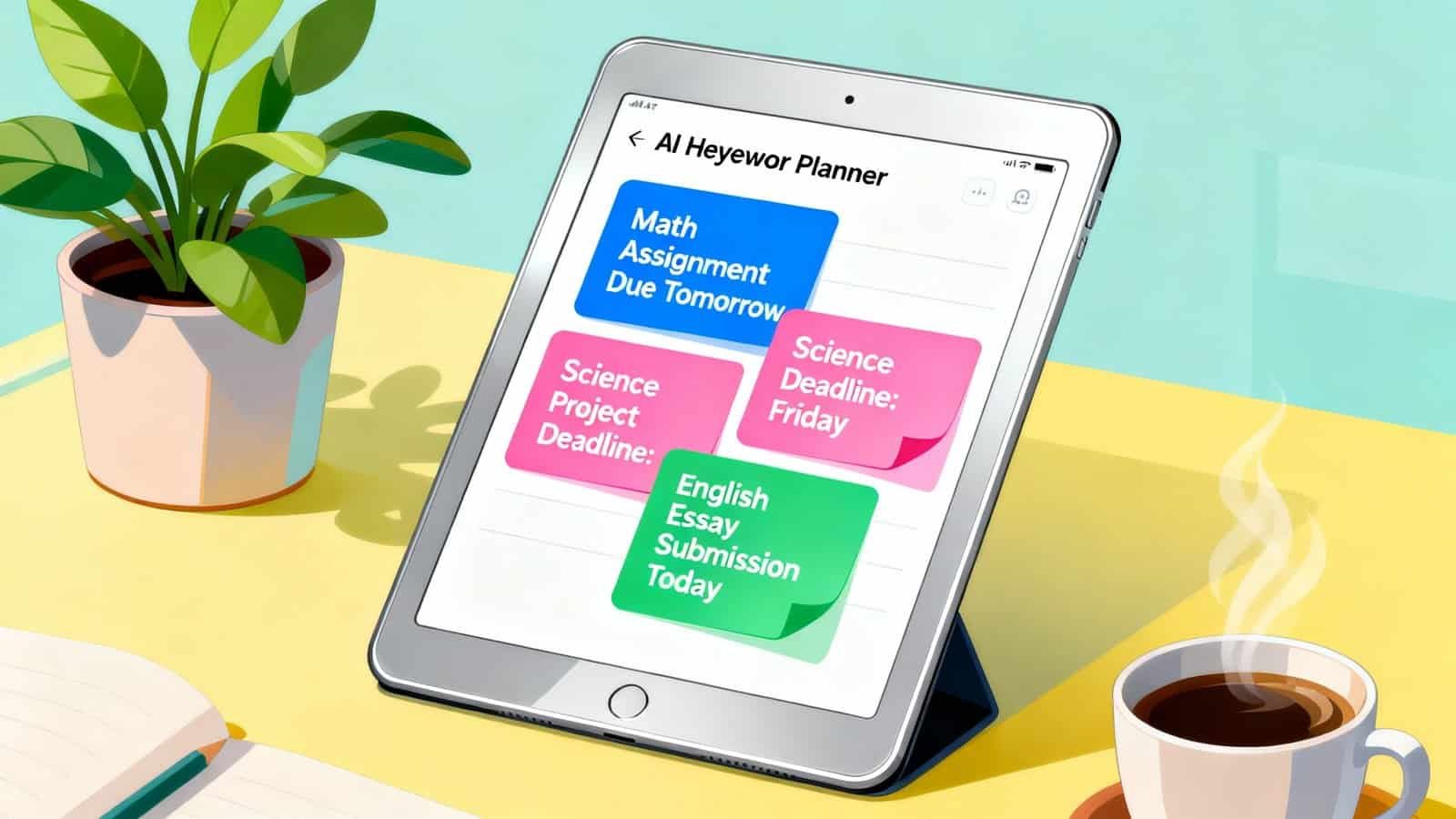
AI homework planners like Motion and Goblin Tools use natural language processing to automatically break down complex assignments into manageable subtasks, addressing ADHD executive function deficits that affect 70% of students. These platforms employ machine learning algorithms to optimize reminder timing around your attention cycles, while multi-modal notifications combat time blindness and hyperfocus episodes. Smart task recognition scans syllabi and emails to extract due dates, while personalized algorithms adapt to your completion patterns and cognitive load patterns for maximum academic success.
Key Takeaways
- AI planners use natural language processing to automatically categorize assignments and generate personalized reminder schedules based on ADHD attention patterns.
- Multi-modal notifications (visual, auditory, haptic) combat time blindness with escalating reminder sequences that adjust to individual focus windows.
- Automated task decomposition breaks complex projects into micro-steps, reducing executive function overwhelm and preventing last-minute cramming behaviors.
- Smart algorithms analyze completion patterns and hyperfocus cycles to optimize study session timing and interrupt unproductive focus periods.
- Top tools like Goblin Tools, Motion, and Todoist AI offer ADHD-specific features while maintaining FERPA-compliant encryption standards.
Understanding ADHD Challenges in Academic Planning
Why do traditional homework planners fail students with ADHD when they need structure most?
Your executive function deficits create specific barriers that standard planning tools can’t address.
Working memory limitations prevent you from retaining multi-step assignment details, while time blindness distorts your perception of deadlines and task duration.
Working memory gaps make you forget assignment steps while time blindness turns next week into tomorrow.
Traditional planners require consistent manual updates and lack the dynamic prompting your ADHD brain needs.
You’ll struggle with initiation paralysis when facing blank planning pages, and sensory sensitivities to paper textures or cluttered layouts can trigger avoidance behaviors.
These failures compound academic self esteem issues, creating a cycle where planning anxiety reduces your willingness to engage with organizational systems.
Your dopamine-seeking brain requires immediate feedback and gamification elements absent in static planners.
Without automated reminders and task breakdown features, you’re left managing complex cognitive demands independently—exactly what ADHD makes most challenging.
How AI-Powered Homework Planners Work
You’ll find that AI-powered homework planners utilize natural language processing algorithms to automatically categorize and prioritize your assignments based on due dates, complexity, and your documented performance patterns.


The smart task recognition technology scans your syllabi, emails, and calendar inputs to extract assignment details without manual data entry.
These systems then deploy machine learning models to generate personalized reminder schedules that adapt to your attention patterns and optimize task completion rates.
Smart Task Recognition Technology
How does artificial intelligence transform scattered homework assignments into organized, manageable tasks?
Smart task recognition technology uses natural language processing algorithms to analyze your assignment descriptions, identifying key components like subject matter, due dates, and complexity levels.
The system’s machine learning models categorize tasks by type—essays, problem sets, readings—while estimating completion timeframes based on your historical performance data.
Edge Processing guarantees your sensitive academic information remains on your device, eliminating cloud-based vulnerabilities while maintaining rapid response times.
This local computation approach supports Privacy Compliance with educational data protection regulations like FERPA.
The AI continuously learns from your interaction patterns, refining task prioritization algorithms to match your ADHD-specific attention cycles and energy levels, creating personalized scheduling recommendations that adapt to your cognitive rhythms.
Automated Reminder Systems
Beyond identifying and categorizing your assignments, AI-powered reminder systems deploy multi-modal notification strategies that align with ADHD cognitive patterns.
These systems utilize spaced repetition algorithms to send notifications at ideal intervals, preventing hyperfocus tunnel vision while maintaining task awareness.

You’ll receive visual, auditory, and haptic alerts across devices, with timing based on your attention patterns and deadline proximity.
Cross platform syncing guarantees reminders follow you seamlessly between smartphone, tablet, and desktop environments.
The AI analyzes your response patterns to failed notifications, automatically adjusting delivery methods and frequency.
Privacy implications require careful consideration—your behavioral data generates personalized reminder profiles, but this sensitive information needs robust encryption and user control.
Smart escalation protocols intensify reminder urgency as deadlines approach, while respecting your preferred communication channels and schedule constraints.
Key Features That Support ADHD Students
You’ll find that effective AI homework planners incorporate specific features designed to address ADHD-related executive function challenges.
Visual task organization transforms abstract assignments into concrete, spatially-arranged elements that reduce cognitive load and improve task comprehension.
Customizable alert systems adapt to your unique attention patterns, delivering personalized notifications that account for hyperfocus periods and attention fluctuations.
Visual Task Organization
When traditional text-based to-do lists overwhelm ADHD brains with cognitive load, visual task organization transforms homework management into an intuitive, scannable system.
AI homework planners leverage gestalt principles to group related assignments through color coding, spatial positioning, and visual hierarchy.

You’ll process information faster when tasks cluster by subject, priority level, or deadline proximity.
Strategic negative space prevents visual clutter that triggers ADHD overwhelm.
The interface separates task categories with deliberate whitespace, reducing cognitive interference between different homework elements.
You can instantly identify urgent assignments through progressive visual indicators—red borders for overdue items, yellow highlights for today’s tasks, green backgrounds for completed work.
This systematic visual approach eliminates decision fatigue while supporting your brain’s natural pattern recognition capabilities for sustained focus.
Customizable Alert Systems
ADHD students frequently miss deadlines because standard notification systems fire alerts at predetermined intervals that don’t align with individual attention patterns and executive function needs.
You need customizable alert systems that adapt to your cognitive rhythms.
Configure notification timing based on task complexity, your focus windows, and historical completion data.
Set escalating reminder sequences that increase frequency as deadlines approach.
Choose from multiple notification types: visual pop-ups, audio cues, vibration patterns, or email alerts.
Interface themes should accommodate sensory sensitivities through adjustable brightness, contrast ratios, and color schemes.
Accessibility widgets enable quick alert customization without traversing complex menus.
Machine learning algorithms analyze your response patterns to optimize alert timing automatically, reducing notification fatigue while maintaining task awareness.
Breaking Down Complex Assignments Into Manageable Tasks
Large assignments trigger executive dysfunction in students with ADHD because the brain’s prefrontal cortex struggles to sequence multi-step processes and estimate time requirements accurately.
AI homework planners address this neurological challenge through automated task decomposition algorithms that parse complex projects into discrete, actionable components.
The system analyzes assignment parameters—length, complexity, research requirements—and generates granular subtasks with specific deliverables.
You’ll receive step-by-step breakdowns that eliminate overwhelming cognitive load while maintaining project coherence.
Resource allocation features distribute workload across available time slots, preventing last-minute cramming that exacerbates ADHD symptoms.
Milestone sequencing creates logical progression checkpoints, establishing clear dependencies between tasks.
Each milestone includes completion criteria and estimated duration, enabling you to track progress systematically.
The AI continuously recalibrates timelines based on your completion patterns, adjusting subsequent task scheduling to accommodate processing speed variations.
This structured approach transforms paralyzing mega-projects into achievable daily objectives.
Smart Reminder Systems for Time Blindness and Hyperfocus
Because ADHD brains exhibit altered dopamine signaling in regions governing temporal perception, students frequently lose track of time during hyperfocus episodes or underestimate task duration due to time blindness.
AI homework planners combat these challenges through multi-modal reminder systems that penetrate hyperfocus states.
You’ll benefit from graduated alert sequences: gentle notifications escalate to persistent vibrations, then auditory alarms.
Smart systems detect your focus patterns and adjust reminder intensity accordingly.
When you’re deeply engaged, the AI triggers Environmental Cues like automated lighting changes or desktop background shifts to break hyperfocus without jarring interruption.
Social Accountability features connect you with study partners or mentors who receive notifications when you miss deadlines.
The AI sends automated check-in messages to your accountability network, creating external pressure that compensates for internal time perception deficits.
Location-based reminders activate when you enter specific spaces, while biometric integration monitors stress levels to optimize reminder timing for maximum effectiveness.
Personalized Learning Pattern Recognition
While smart reminders address temporal challenges, AI homework planners excel at identifying your unique cognitive rhythms and learning preferences through continuous behavioral analysis.
The system tracks your engagement patterns across different subjects, times, and environments to establish your individual Learning Archetypes.
Through Pace Profiling algorithms, the AI maps your ideal study durations and identifies when hyperfocus naturally occurs versus when you struggle with sustained attention.
- Cognitive load analysis monitors your response time and accuracy patterns to determine when you’re operating at peak capacity versus experiencing mental fatigue
- Subject-specific performance tracking identifies which topics benefit from shorter, frequent sessions versus extended deep-work blocks
- Environmental correlation mapping connects your productivity levels to external factors like time of day, location, and ambient conditions
- Attention span modeling predicts your focus windows and automatically adjusts task complexity accordingly
This data-driven approach eliminates guesswork, allowing the AI to recommend personalized study schedules that align with your neurological patterns rather than fighting against them.
Top AI Homework Planning Tools and Platforms

| Platform | Key AI Feature | ADHD-Specific Benefits | Data Privacy Rating |
|---|---|---|---|
| Goblin Tools | Task decomposition NLP | Reduces overwhelm through micro-stepping | High encryption standards |
| Motion | Predictive rescheduling | Adapts to actual completion patterns | GDPR compliant |
| Todoist AI | Pattern recognition analytics | Identifies procrastination triggers | End-to-end encryption |
| Focus Keeper | Attention span modeling | Customizes work intervals | Local data storage |
User reviews consistently highlight these platforms’ effectiveness in reducing executive dysfunction symptoms while maintaining robust data privacy protocols through encrypted storage systems.
Implementation Strategies for Academic Success
Implementing AI homework planning tools requires systematic configuration tailored to your specific ADHD symptoms and academic workload patterns. Begin by inputting your complete academic schedule, including assignment deadlines, exam dates, and recurring commitments. Configure notification preferences to match your attention patterns—frequent, gentle reminders work better than sporadic alerts for ADHD brains.
Optimize your Study Environment by eliminating digital distractions during focused work sessions. Enable airplane mode or use website blockers when the AI scheduler designates deep work periods.
- Set up automated break reminders every 25-45 minutes to prevent hyperfocus burnout
- Create task hierarchies with clear priority levels based on deadline proximity and complexity
- Establish Peer Accountability partnerships through shared calendar integration
- Configure reward triggers that activate after completing predetermined milestone achievements
Monitor your completion rates weekly and adjust the AI’s parameters accordingly. The system learns your patterns, but you’ll need to fine-tune settings based on real performance data.
Frequently Asked Questions
How Much Do AI Homework Planners Typically Cost per Month?
You’ll find AI homework planners cost $5-30 monthly across different subscription tiers.
Basic plans start at $5-10, offering core scheduling features, while premium tiers reach $20-30 with advanced AI analytics and personalized ADHD accommodations.
When conducting value comparison, you’re paying for algorithmic sophistication—higher-priced platforms typically integrate machine learning models that adapt to your specific attention patterns and provide predictive task prioritization based on your historical completion data.
Are AI Homework Planners Compatible With School Learning Management Systems?
Most AI homework planners offer LMS integration through standard API connections with Canvas, Blackboard, Google Classroom, and Schoology.
You’ll find REST API standards enable automatic assignment importing, due date synchronization, and grade passback functionality. However, implementation varies considerably between platforms.
You should verify specific integration capabilities with your school’s LMS before purchasing, as some planners require manual setup or administrative approval for full API access.
What Age Range Are These AI Homework Planners Designed For?
You’ll find AI homework planners targeting ages 8-18, spanning elementary learners through high schoolers.
Most platforms implement age-specific interfaces and cognitive load adjustments.
Elementary learners receive visual scheduling with simplified task breakdowns, while high schoolers access advanced project management features.
The systems adapt reminder frequency and complexity based on developmental stages.
However, you’ll need to verify specific age compatibility since some platforms focus exclusively on middle school through high school implementation.
Do AI Homework Planners Work Offline or Require Internet Connection?
Most AI homework planners require internet connectivity for full functionality, though some offer limited offline capabilities through local processing of cached data.
You’ll find basic features like viewing previously synced assignments and reminders work offline, but AI-powered task prioritization and intelligent scheduling need active connections.
Cache syncing occurs when you reconnect, updating your local data with server-side changes and new AI recommendations.
Can Parents Access Their Child’s AI Homework Planner Progress Reports?
Yes, you can configure access permissions to allow parents viewing progress reports, though privacy concerns require careful implementation.
Most AI homework planners offer tiered permission systems where you’ll set granular controls for what data parents access.
You’ll need to balance transparency with student autonomy, ensuring compliance with educational privacy regulations like FERPA while maintaining the therapeutic benefits for ADHD students.
Conclusion
You’ll optimize your academic performance by selecting AI homework planners that implement evidence-based ADHD accommodations: task decomposition algorithms, interval-based reminder systems, and adaptive scheduling. Configure notification frequencies based on your attention patterns—typically 15-30 minute intervals for task switches. Monitor your engagement metrics weekly to refine AI parameters. Integrate these tools with existing assistive technologies and establish consistent digital workflows. Your success depends on systematic implementation and continuous calibration of AI features to match your neurological processing patterns.
Table of Contents
- 1 Key Takeaways
- 2 Understanding ADHD Challenges in Academic Planning
- 3 How AI-Powered Homework Planners Work
- 4 Key Features That Support ADHD Students
- 5 Breaking Down Complex Assignments Into Manageable Tasks
- 6 Smart Reminder Systems for Time Blindness and Hyperfocus
- 7 Personalized Learning Pattern Recognition
- 8 Top AI Homework Planning Tools and Platforms
- 9 Implementation Strategies for Academic Success
- 10 Frequently Asked Questions
- 10.1 How Much Do AI Homework Planners Typically Cost per Month?
- 10.2 Are AI Homework Planners Compatible With School Learning Management Systems?
- 10.3 What Age Range Are These AI Homework Planners Designed For?
- 10.4 Do AI Homework Planners Work Offline or Require Internet Connection?
- 10.5 Can Parents Access Their Child’s AI Homework Planner Progress Reports?
- 11 Conclusion








No Comments