
You’ll boost your rankings with these seven essential SEO tools: SEMrush delivers extensive competitive analysis and keyword intelligence, while Ahrefs provides massive backlink data across 16 trillion indexed links. Google Search Console offers authoritative insights directly from Google’s indexing system. Screaming Frog excels at technical audits, identifying crawl errors and site issues. Moz Pro combines user-friendly management with proprietary Domain Authority metrics. Ubersuggest provides cost-effective keyword research, and Yoast optimizes WordPress content implementation. Each tool addresses specific optimization challenges that we’ll explore further.
Key Takeaways
- SEMrush provides comprehensive competitor analysis, keyword research with difficulty scores, and AI-powered technical audits for complete SEO intelligence.
- Ahrefs dominates backlink analysis with 16 trillion indexed links and offers powerful keyword gap analysis across millions of terms.
- Google Search Console delivers authoritative insights directly from Google including performance data, indexing status, and Core Web Vitals metrics.
- Screaming Frog SEO Spider conducts thorough technical audits by crawling sites to identify broken links, duplicate content, and optimization issues.
- Moz Pro combines user-friendly keyword research, rank tracking, and site auditing with proprietary Domain Authority metrics starting at $99/month.
SEMrush: The All-in-One SEO Powerhouse
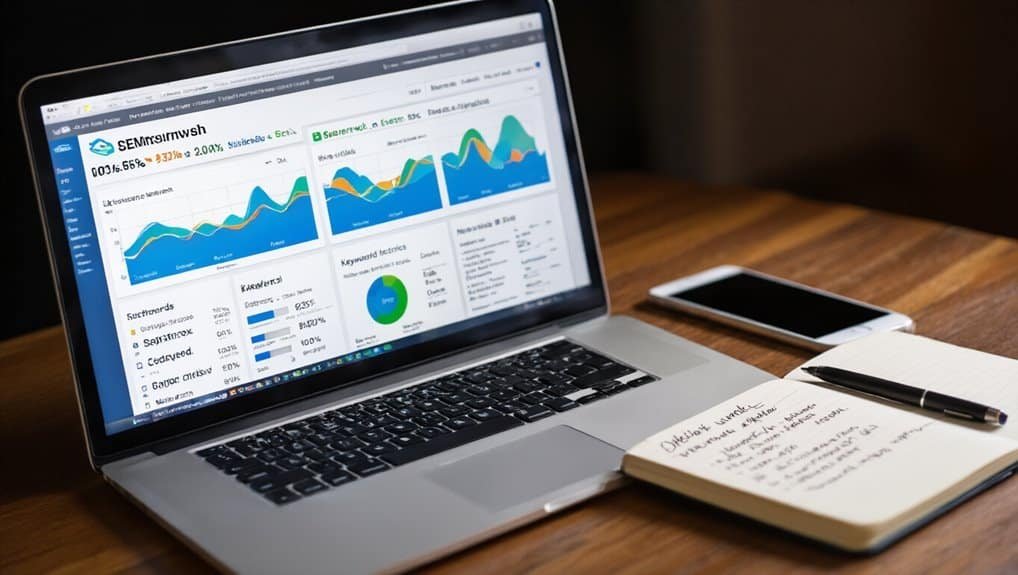
When you’re scaling up your SEO strategy, SEMrush delivers all-encompassing data intelligence that transforms how you approach organic search optimization. You’ll access exhaustive competitor analysis, revealing their top-performing keywords, backlink profiles, and content gaps within your niche.
The platform’s keyword research capabilities extend beyond basic volume metrics, providing keyword difficulty scores, SERP feature analysis, and seasonal trend data. You can identify high-value opportunities through their Keyword Gap tool, which pinpoints terms your competitors rank for while you don’t.
SEMrush’s content clustering functionality organizes related keywords into topic groups, enabling you to create exhaustive content strategies that capture entire search intent spectrums. Their AI automation features streamline technical audits, automatically flagging critical site issues like broken links, crawl errors, and mobile optimization problems.
The backlink analysis module tracks your link-building progress while monitoring competitor acquisition strategies, helping you identify authoritative domains for outreach campaigns and disavow toxic links damaging your rankings.
Ahrefs: Advanced Backlink Analysis and Keyword Research
Ahrefs distinguishes itself through its massive crawling infrastructure that indexes over 16 trillion known links, providing you with the most exhaustive backlink database in the SEO industry. You’ll access unprecedented visibility into competitor link profiles, enabling strategic analysis of their acquisition patterns and domain authority sources.
Ahrefs’ 16 trillion link database delivers unmatched competitor backlink intelligence for strategic SEO advantage.
The platform’s keyword gap analysis reveals untapped opportunities by comparing your rankings against competitors across millions of keywords. You can identify content gaps where competitors rank but you don’t, prioritizing high-impact keyword targets for your strategy.
Ahrefs’ Site Explorer delivers thorough domain metrics including organic traffic estimates, top-performing pages, and linking domain breakdowns. The Keywords Explorer provides accurate search volumes, keyword difficulty scores, and SERP feature data across 171 countries.
You’ll leverage advanced filters to segment backlink data by attributes like domain rating, traffic, and link type. The Content Explorer identifies viral content in your niche, uncovering link-worthy topics and successful content formats driving engagement.
Google Search Console: Essential Free Insights From Google
Google Search Console stands out as the definitive source for understanding how Google perceives and indexes your website, delivering direct insights from the search engine that matters most.


You’ll access critical data about your site performance through thorough reports covering search queries, click-through rates, and average positions. The platform reveals exactly which keywords drive traffic to your pages and identifies optimization opportunities you’re missing.
Monitor your indexing status through real-time coverage reports that highlight crawl errors, mobile usability issues, and security problems. You’ll receive immediate notifications when Google encounters technical problems affecting your site’s visibility.
The Performance report shows search impressions, clicks, and position data filtered by queries, pages, countries, and devices. Core Web Vitals assessments provide actionable speed and user experience metrics directly impacting rankings.
Submit sitemaps, request URL indexing, and track mobile-first indexing progress. Google Search Console eliminates guesswork by providing authoritative data straight from Google’s crawling and ranking systems.
Screaming Frog SEO Spider: Technical Audit Excellence

You’ll find Screaming Frog SEO Spider indispensable for conducting thorough technical audits that crawl every accessible page on your website.
This desktop tool systematically identifies critical technical issues including broken links, duplicate content, missing meta descriptions, and server errors that impact your search rankings.
The spider’s all‑encompassing crawling capabilities reveal structural problems and optimization opportunities that manual analysis would miss, giving you actionable data to prioritize your technical SEO improvements.
Comprehensive Site Crawling
Crawling through every corner of your website reveals the technical foundation that determines your search engine performance. Screaming Frog‘s all-encompassing crawling capabilities systematically analyze every URL, uncovering critical issues that impact your rankings. You’ll identify broken links, duplicate content, and missing meta descriptions across thousands of pages simultaneously.
The tool’s advanced site indexing functionality maps your entire website structure, revealing orphaned pages and internal linking gaps. Through detailed link mapping, you’ll visualize how PageRank flows through your site architecture. The crawler detects redirect chains, server errors, and oversized pages that slow loading speeds.
Real-time data extraction provides actionable insights for technical optimization. You’ll export all-encompassing reports showing exact issues requiring immediate attention, enabling strategic fixes that improve crawlability and search engine visibility.

Technical Issues Detection
When technical problems lurk beneath your website’s surface, Screaming Frog’s diagnostic engine pinpoints exact performance bottlenecks that search engines penalize. You’ll identify critical indexing errors that prevent pages from appearing in search results, while mobile rendering issues become immediately visible through thorough device simulation.
The tool’s technical audit capabilities expose hidden problems:
- Response code analysis – Detects 404s, redirects, and server errors across thousands of URLs
- Meta data validation – Identifies missing titles, duplicate descriptions, and over-optimization
- Internal linking structure – Maps broken links and orphaned pages affecting crawl efficiency
- Page speed diagnostics – Highlights loading bottlenecks impacting user experience metrics
You’ll receive actionable data that transforms technical debt into ranking opportunities, enabling strategic fixes that directly improve search visibility and organic traffic performance.
Moz Pro: User-Friendly SEO Management Platform

You’ll find Moz Pro stands out as one of the most accessible enterprise-level SEO platforms, combining thorough keyword research, rank tracking, and site auditing capabilities within an intuitive interface.
The platform’s strategic value centers on its proprietary Domain Authority metric and extensive SERP analysis tools that help you prioritize optimization efforts based on competitive intelligence.
Understanding Moz Pro’s feature set and pricing structure becomes essential when evaluating whether this platform aligns with your SEO workflow requirements and budget constraints.
Key Features Overview
As one of the most established names in SEO software, Moz Pro delivers an all-encompassing suite of tools designed to streamline your search optimization workflow.
You’ll access thorough rank tracking across desktop and mobile platforms, ensuring your mobile optimization strategies yield measurable results.
The platform’s core capabilities include:
- Keyword Explorer – Discover high-value search terms with accurate difficulty scores and SERP analysis
- Site Crawl – Identify technical issues impacting your search performance with automated auditing
- Link Explorer – Analyze backlink profiles and uncover link-building opportunities
- Page Optimization – Receive actionable recommendations for on-page improvements
You’ll leverage content clustering insights through Moz’s keyword grouping functionality, enabling strategic content planning.
The dashboard consolidates critical metrics, allowing data-driven decision-making without switching between multiple interfaces.
Pricing Plans Breakdown
Moz Pro structures its pricing across four distinct tiers, each calibrated to match specific business scales and SEO requirements.
The Standard plan ($99/month) targets small businesses with 300 keyword tracking and basic campaign management.
Medium ($179/month) expands capacity to 750 keywords with enhanced competitive analysis.
Large ($299/month) accommodates enterprise needs with 1,500 keywords and advanced reporting capabilities.
Premium ($599/month) delivers maximum functionality including 3,000 keywords and priority support.
When evaluating subscription tiers, you’ll find each level maintains core functionalities while scaling data limits and advanced features.
Feature comparisons reveal consistent access to Moz’s keyword explorer, link analysis, and site crawling across all plans.
The pricing structure guarantees you’re paying proportionally for increased data capacity rather than restricted tool access, making upgrades seamless as your SEO requirements expand.
Ubersuggest: Budget-Friendly Keyword Discovery Tool
Neil Patel’s Ubersuggest stands out as a cost-effective alternative that delivers exhaustive keyword research capabilities without the premium price tag of enterprise-level tools.
You’ll discover thorough data on search volume, competition metrics, and seasonal trends that inform strategic decision-making. The platform excels at identifying long tail opportunities that competitors often overlook, giving you tactical advantages in content planning.
Ubersuggest’s competitive analysis features reveal critical insights:
- Competitor keywords analysis shows which terms drive traffic to rival sites
- Content gaps identification highlights untapped opportunities in your niche
- Local intent targeting helps optimize for geographic-specific searches
- SERP analysis provides ranking difficulty assessments for strategic prioritization
The tool’s content suggestions feature generates topic ideas based on high-performing competitor content, while the site audit functionality identifies technical optimization opportunities. You’ll access historical data spanning 12 months, enabling trend analysis that guides long-term SEO strategy development and resource allocation decisions.
Yoast SEO: WordPress Optimization Made Simple
While thorough keyword research tools like Ubersuggest provide the strategic foundation for SEO success, you’ll need specialized on-page optimization capabilities to implement those insights effectively within WordPress.
Yoast SEO transforms complex SEO implementation into actionable guidance through real-time content analysis. You’ll receive immediate feedback on keyword density, meta descriptions, and title optimization while writing. The plugin’s traffic light system eliminates guesswork—green indicates optimized content, yellow suggests improvements, and red flags critical issues.
Content readability analysis guarantees your pages satisfy both search engines and users by evaluating sentence length, paragraph structure, and passive voice usage. This dual optimization approach directly impacts rankings since Google prioritizes user experience signals.
Schema integration capabilities let you add structured data markup without coding knowledge. You’ll implement rich snippets for articles, products, and local businesses through simple dropdown selections, enhancing your search result visibility and click-through rates while maintaining technical precision across your WordPress site.
Frequently Asked Questions
How Often Should I Run SEO Audits Using These Tools?
You should conduct monthly checks for critical metrics like rankings, traffic, and technical errors to catch issues early.
Perform quarterly in-depth examinations for thorough analysis of site architecture, content gaps, and competitor movements. This frequency balances resource allocation with strategic oversight.
Monthly monitoring prevents ranking drops from escalating, while quarterly audits enable data-driven strategy adjustments and long-term optimization planning.
Can I Use Multiple SEO Tools Simultaneously Without Data Conflicts?
You can absolutely use multiple SEO tools simultaneously without significant data conflicts. Most platforms offer robust third party integrations and standardized data collection methods.
However, you’ll occasionally encounter API synchronization issues when tools pull data at different intervals or use varying methodologies. To minimize discrepancies, establish one primary tool as your baseline for critical metrics and use secondary tools for supplementary insights and cross-validation purposes.
What’s the Minimum Budget Needed for Effective SEO Tool Subscriptions?
You’ll need $50-100 monthly for effective SEO tool coverage.
Starter plans from Ahrefs ($99), SEMrush ($119), or Moz ($99) provide all-encompassing keyword research, rank tracking, and competitor analysis.
Budget-conscious alternatives include Ubersuggest ($29) or SE Ranking ($44) for basic functionality.
Your monthly costs depend on site complexity and feature requirements.
Premium tools deliver superior data accuracy and advanced analytics that justify higher investment for serious optimization strategies.
How Long Before Seeing Ranking Improvements After Using SEO Tools?
You’ll typically see initial ranking improvements within 3-6 months of implementing SEO tools, though competitive keywords may require 6-12 months.
Realistic timelines depend on your site’s authority, competition levels, and implementation quality.
Effective expectations management involves tracking incremental progress through position monitoring, organic traffic growth, and indexation rates.
Technical optimizations show faster results than content-driven strategies, while consistent tool usage accelerates overall performance gains.
Do SEO Tools Work Equally Well for Local and Global Businesses?
SEO tools don’t work equally well for local and global businesses. You’ll find local SEO tools excel at managing citations, Google My Business optimization, and tracking hyperlocal rankings, while enterprise tools better handle international competition analysis and multi-region keyword research.
Local businesses need tools that understand local nuances like proximity factors and review management, whereas global companies require robust technical auditing and cross-market competitive intelligence capabilities.
Conclusion
You’ve now got seven powerful SEO tools that’ll transform your ranking strategy. Deploy SEMrush for exhaustive competitive analysis, leverage Ahrefs’ backlink intelligence, and monitor Google Search Console’s performance metrics religiously. Run technical audits with Screaming Frog, streamline campaigns through Moz Pro, and discover untapped keywords via Ubersuggest. Don’t forget Yoast for on-page WordPress optimization. Your success depends on consistent data analysis and strategic implementation across these platforms.
Table of Contents
- 1 Key Takeaways
- 2 SEMrush: The All-in-One SEO Powerhouse
- 3 Ahrefs: Advanced Backlink Analysis and Keyword Research
- 4 Google Search Console: Essential Free Insights From Google
- 5 Screaming Frog SEO Spider: Technical Audit Excellence
- 6 Moz Pro: User-Friendly SEO Management Platform
- 7 Ubersuggest: Budget-Friendly Keyword Discovery Tool
- 8 Yoast SEO: WordPress Optimization Made Simple
- 9 Frequently Asked Questions
- 9.1 How Often Should I Run SEO Audits Using These Tools?
- 9.2 Can I Use Multiple SEO Tools Simultaneously Without Data Conflicts?
- 9.3 What’s the Minimum Budget Needed for Effective SEO Tool Subscriptions?
- 9.4 How Long Before Seeing Ranking Improvements After Using SEO Tools?
- 9.5 Do SEO Tools Work Equally Well for Local and Global Businesses?
- 10 Conclusion







No Comments