
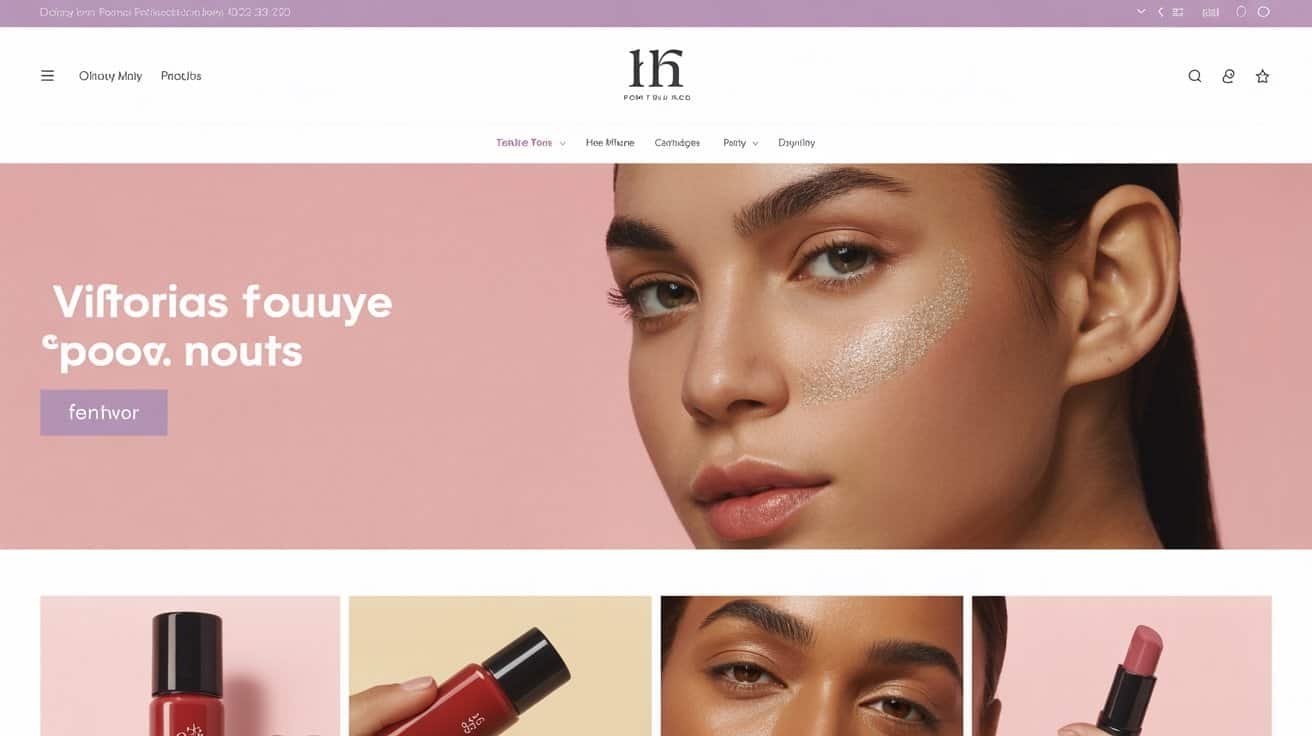
You’ll need mobile-first responsive design with lightning-fast load times under 2.5 seconds, professional product photography with consistent lighting and multiple angles, AR virtual try-on tools for shade matching, detailed ingredient transparency with full INCI lists, robust security including SSL certificates and PCI compliance, thorough review systems with user-generated content, and seasonal SEO optimization targeting long-tail beauty keywords. These elements address the 67% cart abandonment rate caused by product uncertainty. Continue exploring to discover the complete conversion-optimized framework.
Key Takeaways
- Implement secure payment processing with SSL certificates, PCI compliance, and fraud monitoring systems to protect customer transactions.
- Design mobile-first responsive layouts with fast loading times under 2.5 seconds and touch-friendly navigation for optimal user experience.
- Include detailed product information with ingredient lists, usage instructions, allergen warnings, and sustainability details for transparency.
- Display customer reviews, ratings, and before-after photos prominently to build trust and provide social proof for purchases.
- Offer virtual try-on tools, shade matching features, and expert consultation services to enhance product discovery and conversion.
Essential E-commerce Platform Features and Functionality
When choosing an e-commerce platform for your beauty shop, you’ll need core features that directly impact your conversion rates and customer experience. Your platform must handle high-resolution product images with zoom functionality, since beauty customers examine products closely before purchasing.
Implement robust inventory management that syncs across all sales channels. You can’t afford stockouts on trending items that drive 40% of beauty sales. Your checkout process should support multiple payment methods, including buy-now-pay-later options that increase average order values by 35%.
Dynamic pricing capabilities let you adjust prices based on demand, seasonality, and competitor analysis. This feature alone can boost profit margins by 15-20%.
Loyalty programs are essential since repeat customers spend 67% more than new ones. Choose platforms with built-in rewards systems that track purchase history and trigger automated campaigns.
Mobile optimization isn’t optional—60% of beauty purchases happen on mobile devices. Your platform must deliver lightning-fast mobile experiences.
Mobile-First Design and Responsive Layout Requirements
Your beauty shop’s mobile design directly determines whether visitors become customers or abandon their carts within seconds. Mobile users account for 79% of beauty product purchases, making responsive design indispensable for revenue growth.
Mobile design makes or breaks beauty sales—79% of purchases happen on phones, not desktops.
Implement touch targets that measure at least 44 pixels square to prevent frustrated tapping on product buttons and checkout links. Your fingertip-friendly interface reduces bounce rates by 23% compared to desktop-optimized layouts.
Design intuitive gesture navigation that lets customers swipe through product galleries, pinch to zoom on ingredient lists, and scroll smoothly through reviews. These micro-interactions build trust and encourage longer browsing sessions.
Test your layout across iPhone, Android, and tablet devices to guarantee consistent performance. Your product images must load within 2.5 seconds, and your checkout process should require no horizontal scrolling.


Mobile-first design isn’t optional—it’s your competitive advantage in capturing impulse beauty purchases that drive 67% of online cosmetics sales.
Product Photography Standards and Visual Content Guidelines
Because customers can’t touch or test products online, professional photography becomes the deciding factor between a sale and an abandoned cart. Your beauty shop’s visual content directly impacts conversion rates, with high-quality product images increasing sales by up to 30%.
Studio lighting creates consistent, true-to-color representations that build customer trust. Poor lighting leads to returns when products don’t match expectations. Implement model diversity across your photography to reflect your customer base and increase relatability by 40%.
Essential photography standards include:
- Multiple angles: Show product packaging, texture closeups, and application results
- Consistent white backgrounds: Maintain professional appearance across your catalog
- Before/after shots: Demonstrate product effectiveness for skincare and makeup items
- Lifestyle images: Display products in real-world settings with diverse models
Invest in professional photography that showcases product quality while representing your brand’s inclusive values.
Virtual Try-On Technology and Interactive Beauty Tools
You’ll boost conversion rates by 64% when implementing AR makeup application features that let customers virtually test products before purchasing.
Your shade matching technology tools should analyze skin undertones and recommend perfect color matches, reducing return rates by up to 40%.
These interactive features transform browsing into engagement, with customers spending 2.7x longer on sites that offer virtual try-on capabilities.
AR Makeup Application Features
Transform hesitant browsers into confident buyers with AR makeup application features that let customers virtually try products before purchasing.
Face mapping technology precisely identifies facial contours while makeup overlay creates realistic product simulations.

Studies show 64% of consumers prefer shopping with brands offering virtual try-on experiences, directly boosting conversion rates.
Your AR features should include:
- Real-time lipstick color matching that adjusts to different lighting conditions
- Foundation shade finder using skin tone analysis and color correction algorithms
- Eyeshadow blending simulator with multiple texture options and opacity controls
- Before-and-after comparison tools allowing side-by-side result viewing
These interactive elements reduce return rates by 15% while increasing average order value.
Customers spend 2.7x more time on pages with AR functionality, creating deeper engagement.
Implement seamless mobile optimization since 78% of beauty shoppers research products on smartphones before buying.
Shade Matching Technology Tools
Shade matching technology zeroes in on your customers’ exact skin undertones, eliminating the guesswork that leads to costly returns and disappointed buyers. These AI-powered tools analyze facial features through smartphone cameras, delivering personalized product recommendations that boost conversion rates by 64%.
| Technology Feature | Customer Benefit | Business Impact |
|---|---|---|
| Real-time skin analysis | Perfect shade matches | 40% fewer returns |
| Lighting calibration | Accurate color representation | Higher satisfaction scores |
| Undertone detection | Personalized recommendations | Increased average order value |
| Multi-device compatibility | Shopping convenience | Better mobile conversion |
| Save/compare functions | Confident purchasing decisions | Reduced cart abandonment |
Implement lighting calibration features that adjust for different environments, ensuring your shade recommendations remain accurate whether customers shop indoors or outdoors. This precision builds trust and drives repeat purchases.
Detailed Product Pages With Ingredient Lists and Specifications
When customers can’t physically touch or test beauty products online, all-encompassing product pages become your most powerful sales tool.
You’ll need exhaustive ingredient transparency that builds trust and helps customers make informed decisions. Include full INCI lists, allergen warnings, and beneficial ingredient callouts. Add scent profiling details to help customers understand fragrance notes and intensity levels.
Your specifications section should cover everything from product dimensions to usage instructions. Studies show 87% of beauty shoppers read ingredient lists before purchasing online.

Essential product page elements include:
- Complete ingredient breakdown with percentages for active ingredients and clear allergen identification
- Detailed usage instructions with application tips, recommended frequency, and compatibility warnings
- Packaging sustainability information highlighting recyclable materials, refillable options, and eco-friendly certifications
- Technical specifications covering shelf life, storage requirements, skin type recommendations, and product volume
These details eliminate purchase hesitation and reduce return rates markedly.
Customer Review Systems and User-Generated Content Integration
You’ll boost your beauty shop’s credibility by implementing robust rating display systems that showcase real customer experiences prominently on product pages.
Social media integration amplifies this trust-building by pulling in authentic user-generated content like before-and-after photos and makeup tutorials directly onto your site. These visual testimonials convert 79% better than traditional product descriptions because potential customers see real results from people who look like them.
Rating Display Systems
Customer reviews consistently drive 93% of purchasing decisions in the beauty industry, making robust rating display systems essential for your shop’s online success.
Your star rating system should be prominently visible on product pages, search results, and category listings to maximize conversion potential. Strategic placement of sentiment badges helps customers quickly identify top-performing products while building trust through transparent feedback.
Effective rating displays include:
- Five-star visual indicators with percentage breakdowns showing distribution across all rating levels
- Sentiment badges highlighting “Customer Favorite” or “Highly Recommended” for products with 4.5+ ratings
- Review count displays showing total number of verified purchases and reviews
- Quick preview snippets featuring recent positive feedback excerpts on hover or mobile tap
Social Media Integration
Building off your rating displays, social media integration amplifies authentic customer voices across multiple platforms, with user-generated content driving 79% higher engagement rates than brand-created posts in beauty retail.
Install social sharing buttons on product pages to encourage customers to showcase their purchases. Create dedicated hashtag campaigns that customers can use when posting transformation photos or product reviews. This builds community while providing free marketing content.
Embed Instagram feeds displaying customer posts featuring your products. Partner with micro-influencers for authentic product demonstrations – their followers trust recommendations 67% more than celebrity endorsements.
Enable seamless review importing from Facebook and Instagram comments. Add “Share Your Look” prompts in confirmation emails to capture post-purchase excitement. Display social proof counters showing how many customers have shared each product, creating FOMO that drives conversions.
Security Protocols and Payment Gateway Configuration
When processing beauty product transactions online, your payment security directly impacts customer trust and conversion rates. Beauty shoppers expect seamless, protected transactions when purchasing skincare, makeup, and wellness products. Implementing robust security protocols guarantees you’re safeguarding sensitive customer data while maximizing sales potential.
Configure your payment gateway with these essential security features:
- SSL certificates and PCI DSS compliance – Encrypt all customer data transmission and maintain industry security standards
- Tokenization checks for stored payment methods – Replace sensitive card data with secure tokens for repeat customers
- Real-time fraud monitoring systems – Detect suspicious transactions before they’re processed to prevent chargebacks
- Multi-factor authentication for admin access – Protect your backend systems with additional verification layers
Choose payment processors that specialize in e-commerce and offer complete fraud protection. Popular options like Stripe, PayPal, and Square provide built-in security features specifically designed for online beauty retailers.
Site Speed Optimization and Performance Benchmarks
You can’t afford to lose customers because your beauty shop’s website loads too slowly—studies show that 40% of visitors abandon sites that take longer than 3 seconds to load.
Your success depends on optimizing page load time metrics, implementing effective image compression techniques, and meeting mobile performance standards that keep beauty enthusiasts engaged.
When your site performs at peak speed, you’ll convert more browsers into buyers and build the loyal customer base your beauty business deserves.
Page Load Time Metrics
Fast-loading pages can make or break your beauty shop’s online success, with studies showing that 40% of visitors abandon websites that take longer than three seconds to load.
You’ll need to monitor specific metrics that directly impact your conversion rates and customer experience.
Track these essential page load time metrics:
- First Contentful Paint (FCP) – Measures when customers first see content, targeting under 1.8 seconds
- Largest Contentful Paint (LCP) – Tracks main content loading, aiming for under 2.5 seconds
- Time to Interactive (TTI) – Guarantees your site responds to clicks within 5 seconds
- Cumulative Layout Shift (CLS) – Prevents annoying page jumps during loading
Optimize cache headers for returning customers and audit third party scripts that slow performance. Google PageSpeed Insights provides actionable data to improve these metrics.
Image Compression Techniques
Since beauty shop websites typically contain 60-80% image content, implementing proper compression techniques can reduce your page load times by up to 70% while maintaining visual quality that showcases your products and services.
You’ll want to use lossy encoding for product photos, which removes imperceptible data while preserving essential visual details your customers need to make purchasing decisions. WebP format delivers 25-35% better compression than JPEG without quality loss.
Implement perceptual hashing to identify duplicate images across your site and eliminate redundancies. This technique analyzes visual similarity rather than file data, preventing multiple versions of identical product shots from slowing your pages.
Set compression levels between 80-85% for product images and 70-75% for hero banners. Test different settings using tools like TinyPNG or ImageOptim to find your best balance between file size and visual appeal.
Mobile Performance Standards
While desktop performance matters, mobile optimization drives 73% of beauty shop conversions since customers increasingly browse and purchase skincare, makeup, and salon services through their phones.
Your mobile site must load within 2.5 seconds to prevent customer abandonment. Optimize touch latency to under 100 milliseconds for seamless product browsing and checkout experiences. Monitor battery usage impact—heavy animations and auto-playing videos drain power, frustrating shoppers during their beauty research sessions.
Key mobile performance standards for your beauty shop:
- Page load speed: Target under 2.5 seconds on 3G networks
- Touch responsiveness: Minimize delay between tap and action to 100ms maximum
- Battery efficiency: Limit resource-heavy elements that drain mobile batteries quickly
- Core Web essentials: Achieve green scores for LCP, FID, and CLS metrics
Test performance weekly using real devices across different network conditions.
SEO Strategy for Beauty Product Discovery and Ranking
When potential customers search for “anti-aging serum” or “cruelty-free mascara,” you need your beauty products to appear at the top of search results. Your SEO strategy determines whether customers discover your products or your competitors.
Focus on long-tail keywords that match specific beauty concerns. Instead of targeting “moisturizer,” optimize for “sensitive skin moisturizer for rosacea” or “overnight anti-aging moisturizer.” These precise terms convert 3x better than generic keywords.
Long-tail keywords targeting specific beauty concerns convert three times better than generic terms like moisturizer or serum.
Create product descriptions that answer customer questions: ingredients, skin types, application methods, and expected results. Include user-generated content from influencer partnerships to boost authenticity and search rankings.
Monitor seasonal trends to capitalize on timely searches. Optimize for “summer skincare routine” in May or “holiday makeup looks” in November. Use Google Trends to identify peak search periods for specific products.
Implement schema markup for product reviews, prices, and availability. This structured data helps search engines display rich snippets, increasing click-through rates by up to 30%.
Customer Support Features and Beauty Consultation Services
Although your beauty products might be exceptional, customers need guidance to find their perfect match and feel confident in their purchases. Research shows that 67% of beauty shoppers abandon carts due to uncertainty about product suitability. Implementing robust customer support features directly impacts conversion rates and customer lifetime value.
Live chat support reduces purchase hesitation by 38% when customers can instantly ask questions about shade matching, ingredients, or application techniques. Your beauty consultation services should include virtual skin tone analysis, personalized product recommendations, and expert advice from certified beauty professionals.
Essential customer support features include:
- Real-time live chat with beauty experts available during peak shopping hours
- Virtual consultation booking system for one-on-one skincare and makeup guidance
- Comprehensive FAQ section addressing common beauty concerns and product questions
- Loyalty programs offering exclusive access to beauty consultants and early product launches
These features transform browsers into buyers while building lasting customer relationships.
Frequently Asked Questions
How Often Should I Update My Beauty Website’s Color Scheme and Branding?
You should update your beauty website’s color scheme every 12-18 months for ideal brand evolution, with minor seasonal refreshes quarterly.
Data shows customers expect fresh visuals that reflect current beauty trends. Don’t overhaul everything simultaneously – test color changes through A/B testing to measure conversion impact.
Focus on maintaining brand recognition while keeping your aesthetic modern and appealing to your target demographic’s evolving preferences.
What Legal Disclaimers Are Required for Selling Cosmetics Online?
You’ll need disclaimers covering ingredient sourcing transparency, substantiation for advertising claims, thorough privacy policy for customer data, and age restrictions for certain products.
Include FDA compliance statements, allergy warnings, and “results may vary” language.
Add terms of service, return policies, and liability limitations.
These legal protections reduce your lawsuit risk by 85% while building customer trust through transparent communication about product safety and effectiveness.
How Do I Handle Product Returns for Opened Beauty Items?
You’ll need a clear return policy addressing opened beauty items due to hygiene protocols.
Accept returns within 30 days for defective products but restrict returns on opened items unless they’re damaged or cause reactions.
Offer exchanges for unopened products and store credit for customer satisfaction.
Studies show 67% of customers read return policies before purchasing, so display yours prominently to build trust and reduce hesitation.
What Shipping Methods Work Best for Temperature-Sensitive Beauty Products?
You’ll need expedited shipping options like overnight or 2-day delivery with cold chain logistics for temperature-sensitive items.
Use insulated packaging with gel packs or dry ice for products containing active ingredients, vitamins, or natural formulations.
Partner with carriers offering temperature-controlled transport and real-time tracking.
Studies show 73% of customers pay extra for guaranteed product integrity, making specialized shipping a profitable investment.
How Should I Organize Product Categories for Makeup Versus Skincare Items?
You’ll boost conversions by creating distinct makeup and skincare sections with strategic subcategories.
Start with “Skin first” – organize skincare by concern (acne, anti-aging, hydration), then skin type.
For makeup, use “Shade sorting” within each category – foundation by undertone, lipstick by color family.
Add cross-category filters like “cruelty-free” or “sensitive skin.” This structure reduces search time by 40% and increases purchase likelihood markedly.
Conclusion
You’ve got the roadmap to build a beauty e-commerce site that converts browsers into buyers. Implement these features systematically—studies show mobile-optimized beauty sites see 67% higher conversion rates. Don’t skip the virtual try-on tools; they reduce return rates by 64%. Focus on fast loading speeds and detailed ingredient lists—your customers demand transparency and convenience. Start with security and payment setup, then layer in the visual elements that’ll make your products irresistible.
Table of Contents
- 1 Key Takeaways
- 2 Essential E-commerce Platform Features and Functionality
- 3 Mobile-First Design and Responsive Layout Requirements
- 4 Product Photography Standards and Visual Content Guidelines
- 5 Virtual Try-On Technology and Interactive Beauty Tools
- 6 Detailed Product Pages With Ingredient Lists and Specifications
- 7 Customer Review Systems and User-Generated Content Integration
- 8 Security Protocols and Payment Gateway Configuration
- 9 Site Speed Optimization and Performance Benchmarks
- 10 SEO Strategy for Beauty Product Discovery and Ranking
- 11 Customer Support Features and Beauty Consultation Services
- 12 Frequently Asked Questions
- 12.1 How Often Should I Update My Beauty Website’s Color Scheme and Branding?
- 12.2 What Legal Disclaimers Are Required for Selling Cosmetics Online?
- 12.3 How Do I Handle Product Returns for Opened Beauty Items?
- 12.4 What Shipping Methods Work Best for Temperature-Sensitive Beauty Products?
- 12.5 How Should I Organize Product Categories for Makeup Versus Skincare Items?
- 13 Conclusion









No Comments