
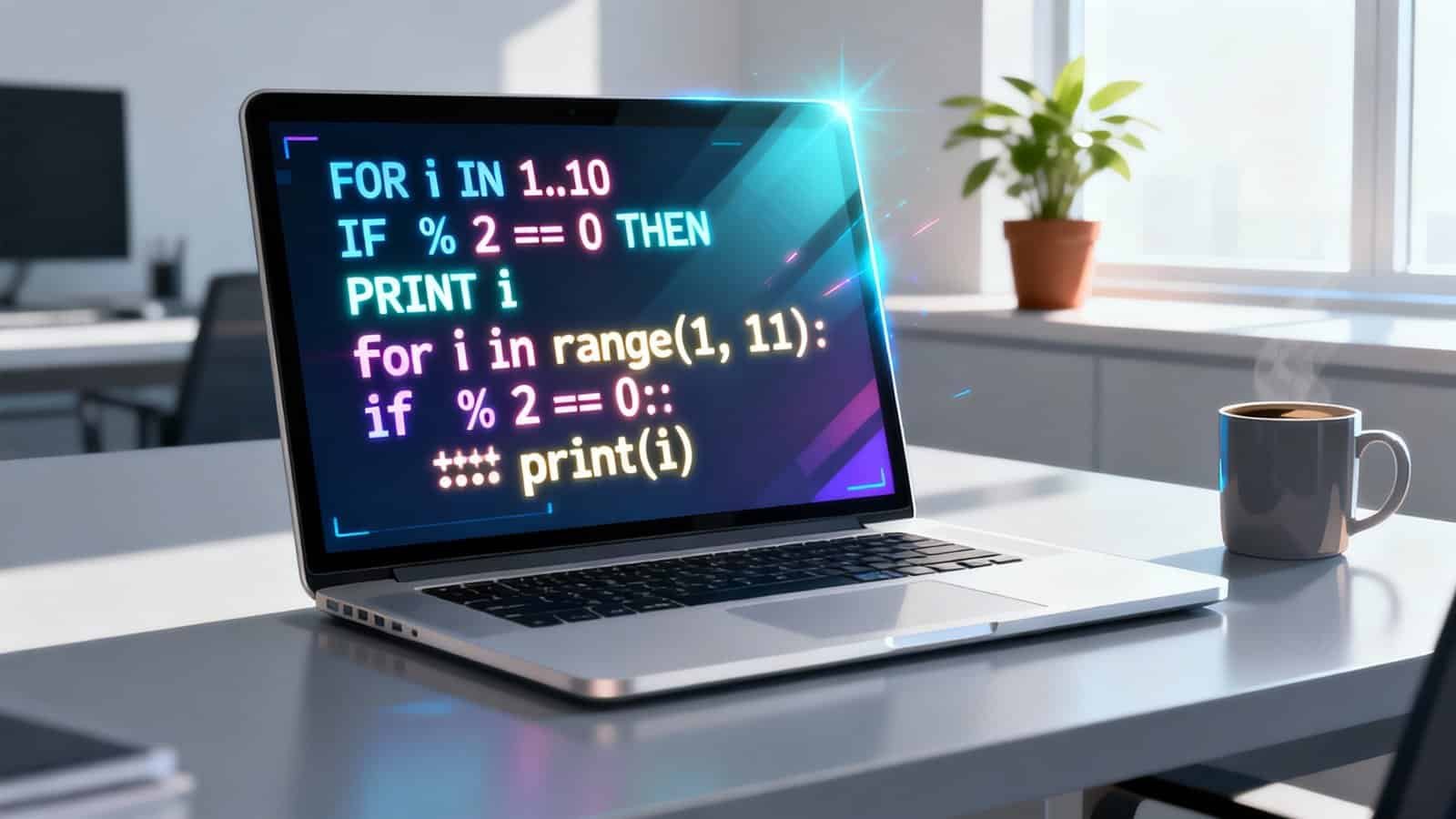
You can use AI tools like ChatGPT, GitHub Copilot, or Replit AI to convert pseudocode into Python by providing clear, well-formatted pseudocode with explicit target language specifications. These tools offer immediate feedback and personalized learning paths, but you’ll need to trace generated code line-by-line, test modifications independently, and maintain proper academic attribution. While AI accelerates development cycles, you must verify logical consistency and understand your institution’s policies regarding AI assistance. The following thorough guide explores optimization strategies and integrity frameworks.
Key Takeaways
- Check your institution’s academic integrity policies before using AI tools and properly attribute any AI assistance in your submissions.
- Use ChatGPT, GitHub Copilot, or Replit AI to translate pseudocode by clearly formatting input and specifying Python as target language.
- Review AI-generated code line-by-line for syntax errors, logic mistakes, and proper indentation before submitting your homework.
- Test individual functions early and trace through code manually to ensure you understand how it works.
- Start with AI assistance for complex parts but gradually attempt similar problems independently to build programming skills.
Understanding the Role of AI in Programming Education

How can artificial intelligence transform the way students learn programming fundamentals like pseudocode conversion?
You’re witnessing a paradigm shift where AI serves as an intelligent tutor, providing immediate feedback and personalized learning paths.
When you struggle with translating logical structures into Python syntax, AI systems can identify specific knowledge gaps and offer targeted interventions.
The cognitive impact extends beyond simple code generation.
You’ll develop pattern recognition skills as AI demonstrates consistent translation methodologies.
This scaffolded approach helps you internalize programming logic rather than memorizing syntax.
However, effective implementation requires extensive teacher training.
Educators must understand AI’s capabilities and limitations to guide students appropriately.
You can’t simply rely on automated conversion; critical thinking remains essential.


Teachers need training to recognize when AI assistance enhances learning versus when it creates dependency.
The goal isn’t replacing human instruction but augmenting pedagogical effectiveness.
You’ll benefit from AI’s precision while developing independent problem-solving capabilities through guided practice.
Popular AI Tools for Pseudocode Translation
Which AI-powered platforms can effectively bridge the gap between pseudocode logic and Python implementation?
Several specialized tools have emerged to address this educational need with varying capabilities and accessibility.
ChatGPT and GPT-4 excel at contextual understanding, translating complex algorithmic descriptions into clean Python code while explaining each step.
GitHub Copilot integrates seamlessly with popular IDEs, offering real-time suggestions as you type pseudocode comments.
CodeWhisperer provides robust platform integrations across multiple development environments, while Replit’s AI assistant offers an educational-focused approach with built-in debugging support.
When conducting a pricing comparison, consider that ChatGPT offers free tiers with usage limits, GitHub Copilot requires monthly subscriptions, and educational discounts are widely available.
Platform integrations vary considerably—some tools work exclusively in web browsers, while others integrate directly into VS Code, PyCharm, or Jupyter notebooks, affecting your workflow efficiency and learning experience.

Step-by-Step Process for Converting Pseudocode Using AI
After selecting your preferred AI tool, you’ll need to follow a systematic approach to guarantee accurate pseudocode translation.
Begin by preparing your pseudocode with clear formatting and proper indentation.
Input the pseudocode into your chosen AI tool, making sure you specify Python as the target language.
Review the generated Python code carefully, checking for logical consistency and syntax accuracy.
Don’t assume the AI output is perfect—verify variable declarations, loop structures, and conditional statements align with your pseudocode logic.
Implement checkpoint testing throughout the process.
Test individual functions or code blocks before proceeding to complete integration.
This approach helps identify errors early and reduces debugging time.
Establish realistic time estimates for your conversion project.
Simple algorithms typically require 15-30 minutes, while complex programs may need several hours.
Factor in additional time for debugging, optimization, and thorough testing to confirm your final Python implementation meets assignment requirements.
Academic Integrity Considerations When Using AI Assistance
When you use AI tools to convert pseudocode to Python, you must understand your institution’s academic honesty policies regarding AI assistance, as these policies vary substantially across educational institutions.
You’re required to properly attribute AI contributions in your work through transparent documentation that specifies which tools you used and how they assisted your coding process.
You’ll need to distinguish between acceptable AI collaboration and prohibited academic misconduct by clearly understanding the boundaries your instructors have established for AI usage in programming assignments.
Understanding Academic Honesty Policies
Academic institutions maintain strict policies regarding the appropriate use of artificial intelligence tools in coursework, and you must understand these guidelines before incorporating AI assistance into your pseudocode-to-Python conversion process.
These policies stem from historical origins in traditional academic honor codes that predate digital technology.
You’ll find cultural variations across institutions—some universities explicitly prohibit AI assistance, while others permit limited use with proper attribution.
Review your institution’s specific guidelines regarding AI tools, as violations can result in serious academic consequences.
Many schools require disclosure when AI assists with assignments.
You must distinguish between using AI as a learning aid versus having it complete work for you.
Understanding these boundaries helps you maintain academic integrity while leveraging AI’s educational benefits responsibly.
Proper AI Attribution Methods
How should you properly attribute AI assistance when converting pseudocode to Python while maintaining academic integrity?
You must transparently document your AI usage throughout the development process.
Include specific tool names, version numbers, and timestamps in your submission comments.
Document which code sections received AI assistance versus your original work.
Many institutions require explicit branding placement within code headers, clearly identifying AI-generated segments.
Some platforms now integrate interface badges that automatically track AI interactions, providing verifiable attribution trails.
Create detailed logs showing your iterative refinement process, demonstrating how you validated, tested, and understood AI-generated solutions.
Submit both your original pseudocode and final Python implementation with thorough attribution documentation.
This transparency guarantees compliance while showcasing your learning progression and critical evaluation skills in AI-assisted programming environments.
Best Practices for Learning While Using AI Tools
As you integrate AI tools into your pseudocode conversion workflow, you must establish deliberate learning practices that prevent over-reliance while maximizing educational value.
Implement metacognitive strategies by questioning each AI-generated solution: “Why did the AI choose this approach?” and “What alternative implementations exist?”
This critical analysis strengthens your understanding beyond surface-level code reproduction.
Maintain reflective journaling to document your learning progression.
Record which concepts you’ve mastered independently versus those requiring AI assistance.
This practice identifies knowledge gaps and tracks genuine comprehension development.
Resist immediately accepting AI outputs.
Instead, trace through generated code line-by-line, ensuring you understand each function, variable, and control structure.
Test modifications independently—change inputs, alter logic flows, or optimize algorithms without AI guidance.
Set progressive independence goals.
Start with AI assistance for complex algorithms, then gradually tackle similar problems solo.
This scaffolded approach builds confidence while developing authentic programming competency rather than dependency.
Common Pitfalls and How to Avoid Them
When converting pseudocode to Python, you’ll encounter two primary categories of errors that can derail your implementation.
Syntax translation errors occur when you incorrectly map pseudocode constructs to Python’s specific syntax rules, while logic structure mistakes arise when you misinterpret the algorithmic flow during translation.
Understanding these pitfall patterns will help you develop systematic approaches to avoid them and produce more accurate code conversions.
Syntax Translation Errors
While pseudocode provides a structured foundation for algorithmic thinking, translating it directly into Python often introduces syntax errors that can frustrate even experienced programmers.
You’ll encounter delimiter mismatches when parentheses, brackets, or quotes aren’t properly paired, causing immediate parsing failures.
Operator precedence differences between pseudocode conventions and Python’s implementation create logical errors that compile successfully but produce incorrect results.
Common syntax translation errors include:
- Indentation inconsistencies – Python requires precise whitespace alignment for block structure
- Variable naming conflicts – Reserved keywords like `class` or `def` can’t serve as identifiers
- Type conversion oversights – Implicit conversions assumed in pseudocode must be explicitly handled
- Boolean expression formatting – Logical operators (`and`, `or`, `not`) differ from mathematical notation
You’ll minimize these errors by systematically reviewing each pseudocode element against Python’s specific requirements.
Logic Structure Mistakes
Beyond syntax errors, logic structure mistakes represent a deeper challenge where your code executes without throwing exceptions yet fails to implement the intended algorithm correctly.
You’ll encounter incorrect nesting when translating nested conditional statements or loops from pseudocode. For instance, placing an else clause at the wrong indentation level fundamentally alters your program’s control flow.
Missing invariants pose another critical issue—you might omit essential conditions that maintain algorithmic correctness throughout execution. When converting pseudocode’s “WHILE condition DO” statements, you must preserve loop invariants that guarantee termination and correctness.
These structural errors often manifest as infinite loops, premature exits, or incorrect branching logic. Careful analysis of pseudocode’s logical hierarchy prevents these implementation failures.
Comparing Manual Conversion Vs Ai-Assisted Methods

Although pseudocode conversion can be accomplished through multiple approaches, you’ll find that manual conversion and AI-assisted methods each offer distinct advantages and trade-offs that directly impact code quality, learning outcomes, and development efficiency.
Choosing between manual and AI-assisted pseudocode conversion requires weighing immediate efficiency against long-term programming skill development.
Manual conversion demands deeper algorithmic understanding but strengthens programming fundamentals through deliberate practice.
You’ll develop stronger debugging skills and syntactic knowledge, though time efficiency suffers substantially.
Conversely, AI-assisted methods accelerate development cycles while maintaining reasonable accuracy for standard algorithms.
Key differences include:
- Learning Depth: Manual conversion reinforces conceptual understanding, while AI assistance may create dependency gaps
- Error Patterns: Human errors typically involve syntax mistakes; AI errors often manifest as logical inconsistencies
- Workflow Preferences: Manual methods suit educational contexts; AI tools excel in rapid prototyping scenarios
- Code Quality: Manual conversion produces more readable, maintainable code with better documentation practices
Your choice depends on whether you prioritize immediate results or long-term skill development.
Preparing for a Future Where AI and Programming Intersect
The landscape of programming continues to evolve as AI tools become increasingly sophisticated, making it imperative that you develop skills that complement rather than compete with artificial intelligence.
Skill forecasting indicates that future programmers must excel in algorithm design, system architecture, and complex problem decomposition—areas where human creativity remains paramount.
You’ll need to master AI tool integration while maintaining deep understanding of computational principles.
Industry collaboration between educational institutions and technology companies reveals emerging competency requirements: critical thinking, code optimization, and cross-functional communication.
Rather than viewing AI as replacement technology, you should leverage it as an enhancement tool for rapid prototyping and iterative development.
Focus on developing meta-cognitive programming skills—understanding why solutions work, not just how they function.
This approach guarantees you remain valuable in an AI-augmented development environment where strategic thinking and architectural decision-making become your primary differentiators in professional programming contexts.
Frequently Asked Questions
Can AI Tools Handle Pseudocode Written in Different Languages or Formats?
Yes, AI tools can handle pseudocode from different languages and formats, though you’ll encounter syntax ambiguity when translating between varied structural conventions.
You must recognize that comment conventions differ markedly across pseudocode styles—some use // while others prefer /* */ or #.
AI’s effectiveness depends on how clearly you’ve defined your pseudocode’s logical flow, regardless of its original linguistic or stylistic format.
Do AI Converters Work With Complex Data Structures Like Trees and Graphs?
Yes, AI converters effectively handle complex data structures like trees and graphs. You’ll find they maintain structure fidelity by preserving hierarchical relationships, node connections, and traversal algorithms during conversion.
These tools provide visualization support, helping you understand the translated code’s logical flow.
However, you must verify that recursive implementations, pointer references, and memory management translate correctly, as pseudocode abstractions don’t always capture Python’s specific object-oriented nuances.
How Much Does Premium AI Pseudocode Conversion Software Typically Cost?
You’ll find premium pseudocode conversion software ranges from $15-50 monthly for individual subscription tiers, while enterprise licensing costs $500-2000 annually per seat.
Advanced platforms offering complex algorithmic translation, debugging capabilities, and educational frameworks command higher prices.
You’re paying for sophisticated parsing engines that handle intricate data structures and maintain semantic accuracy.
Academic institutions often negotiate volume discounts, making enterprise solutions more cost-effective for classroom deployment.
Will Using AI Tools Make Me Dependent and Hurt Job Prospects?
Excessive AI reliance can cause skill atrophy, weakening your fundamental programming abilities employers value. You’ll struggle with interview preparedness when faced with coding challenges requiring independent problem-solving.
However, strategic AI usage as a learning supplement—not replacement—enhances understanding. Balance is essential: use AI to accelerate comprehension while consistently practicing manual coding.
This approach develops both technical competency and adaptive thinking skills essential for professional success.
Can AI Handle Pseudocode With Mathematical Formulas and Scientific Calculations?
Yes, you can leverage AI for mathematical pseudocode conversion, though you’ll encounter limitations in symbolic understanding of complex mathematical relationships.
AI excels at translating standard algorithms but may struggle with domain-specific notation or theoretical concepts.
You must verify numerical precision carefully, as AI can introduce rounding errors or misinterpret mathematical operations.
Always validate outputs against known solutions to confirm computational accuracy and mathematical correctness.
Conclusion
You’ll find that AI tools can effectively accelerate your pseudocode-to-Python conversion, but they’re most valuable when you understand the underlying logic you’re translating. Don’t let AI replace your critical thinking—use it to verify your approach and catch syntax errors. You must maintain academic integrity by following your institution’s policies and ensuring you can explain every line of generated code. Master both manual conversion and AI-assisted methods to prepare for professional programming environments.
Table of Contents
- 1 Key Takeaways
- 2 Understanding the Role of AI in Programming Education
- 3 Popular AI Tools for Pseudocode Translation
- 4 Step-by-Step Process for Converting Pseudocode Using AI
- 5 Academic Integrity Considerations When Using AI Assistance
- 6 Best Practices for Learning While Using AI Tools
- 7 Common Pitfalls and How to Avoid Them
- 8 Comparing Manual Conversion Vs Ai-Assisted Methods
- 9 Preparing for a Future Where AI and Programming Intersect
- 10 Frequently Asked Questions
- 10.1 Can AI Tools Handle Pseudocode Written in Different Languages or Formats?
- 10.2 Do AI Converters Work With Complex Data Structures Like Trees and Graphs?
- 10.3 How Much Does Premium AI Pseudocode Conversion Software Typically Cost?
- 10.4 Will Using AI Tools Make Me Dependent and Hurt Job Prospects?
- 10.5 Can AI Handle Pseudocode With Mathematical Formulas and Scientific Calculations?
- 11 Conclusion









No Comments